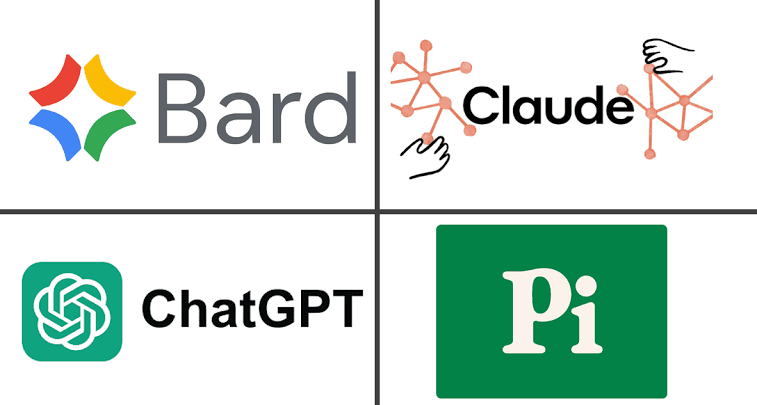
Artificial intelligence has advanced rapidly in recent years, introducing powerful tools capable of understanding and generating human language. Among the most well-known examples are ChatGPT, Google Bard (now called Gemini), and Anthropic Claude. These systems are widely used for tasks such as answering questions, writing content, assisting with coding, and providing conversational support. Many people encounter these tools daily but may wonder what type of generative AI models power them.
ChatGPT, Google Bard, and Anthropic Claude belong to a category of artificial intelligence known as Large Language Models, often abbreviated as LLMs. These models are specifically designed to process and generate natural language, allowing computers to communicate in ways that resemble human conversation.
Understanding Generative AI
Generative AI refers to a type of artificial intelligence that can create new content based on patterns it has learned from training data. Unlike traditional AI systems that mainly analyze or classify information, generative AI produces outputs such as text, images, audio, or code.
Generative AI models learn by analyzing massive datasets that contain examples of human-created content. By identifying patterns within this data, the models learn how to generate similar content when given a prompt or instruction.
In the case of ChatGPT, Bard, and Claude, the generated content is primarily text. These systems respond to user questions, create written material, summarize information, and engage in conversational dialogue.
What Are Large Language Models (LLMs)?
Large Language Models are advanced deep learning systems trained to understand and generate human language. They are called “large” because they contain billions or even trillions of parameters, which are internal values that help the model interpret and produce text.
LLMs are trained using enormous collections of books, articles, websites, and other written materials. During training, the model learns how words and sentences relate to each other, enabling it to predict the most appropriate sequence of words in a response.
Because of this training process, LLMs can perform a wide variety of language-related tasks without being explicitly programmed for each one.
The Transformer Architecture Behind LLMs
Most modern large language models are built using a neural network design known as the transformer architecture. This architecture was introduced in 2017 and quickly became the foundation for many advanced AI systems.
The transformer model uses a mechanism called attention, which allows the AI to analyze relationships between words in a sentence. Instead of processing text strictly in order, the model can examine multiple parts of the sentence simultaneously to understand context.
This capability allows large language models to generate more coherent and contextually accurate responses compared to earlier natural language processing systems.
ChatGPT as a Large Language Model
ChatGPT is developed by OpenAI and is part of the Generative Pre-trained Transformer (GPT) family of models. The system is trained on vast amounts of text data and fine-tuned to interact conversationally with users.
ChatGPT can perform tasks such as answering questions, generating articles, assisting with programming, explaining complex topics, and helping users brainstorm ideas. Because of its conversational design, it is widely used in customer support, education, content creation, and software development.
Google Bard and Gemini Models
Google originally introduced Bard as its conversational AI chatbot. Bard was powered by large language models developed by Google, and the system has since evolved into what is now known as Gemini.
Google’s AI models are designed to integrate with the company’s ecosystem of services, including search, productivity tools, and cloud platforms. Like other large language models, Gemini can understand prompts, generate detailed responses, and assist users with various knowledge-based tasks.
Google continues to invest heavily in AI research to expand the capabilities of its language models and improve their reasoning, accuracy, and real-time information retrieval.
Anthropic Claude and AI Safety
Claude is a conversational AI developed by Anthropic, a company focused on building reliable and safe artificial intelligence systems. Anthropic emphasizes responsible AI development and alignment, meaning the models are designed to follow guidelines and avoid generating harmful outputs.
Claude operates as a large language model capable of generating detailed explanations, assisting with writing tasks, analyzing documents, and answering questions. Many organizations use Claude for research assistance, knowledge work, and business applications.
Capabilities of Large Language Models
Large language models are highly versatile because they can perform many tasks involving human language. Some of the most common capabilities include:
- Conversational AI and chat-based assistance
- Content writing and editing
- Text summarization
- Language translation
- Programming support and code generation
- Research assistance
- Customer support automation
These capabilities make LLMs useful across many industries, including education, healthcare, technology, marketing, and finance.
Why Large Language Models Are Important
Large language models represent a major breakthrough in artificial intelligence because they allow machines to interact with humans using natural language. This reduces the need for complex interfaces and enables people to communicate with technology more intuitively.
Businesses use LLMs to automate customer interactions, assist employees with research, generate marketing content, and improve productivity. Developers also integrate these models into applications to build smarter digital tools.
As the technology continues to improve, large language models are expected to become even more capable, supporting advanced reasoning, multimodal understanding, and more personalized interactions.
Future of Generative AI Language Models
The future of generative AI will likely involve even more powerful language models that can process multiple types of data, including images, audio, and video. Researchers are also working on improving factual accuracy, reducing bias, and ensuring responsible AI behavior.
Advancements in computing power and training techniques will allow companies to build models with greater reasoning abilities and broader knowledge. These improvements will expand the use of AI assistants across industries and everyday life.
Conclusion
ChatGPT, Google Bard (Gemini), and Anthropic Claude are examples of large language models, a powerful type of generative AI designed to understand and produce human language. Built using transformer-based neural networks and trained on massive text datasets, these models can perform a wide range of tasks including conversation, writing, research assistance, and coding support. As artificial intelligence continues to evolve, large language models will play a central role in shaping the future of digital communication and intelligent technology.

As a digital marketer, she has received multiple international awards, including Campaign of the Year at the 2023 European Content Awards and Best Use of Content Marketing at the 2022 Global Search Awards. Nicai holds an MSc in Marketing (First Class Honours) from the UCD Smurfit Graduate Business School and she has also completed the Artificial Intelligence Programme at Oxford University’s Saïd Business School. She is also a contributing writer for publications such as Entrepreneur and Esquire.