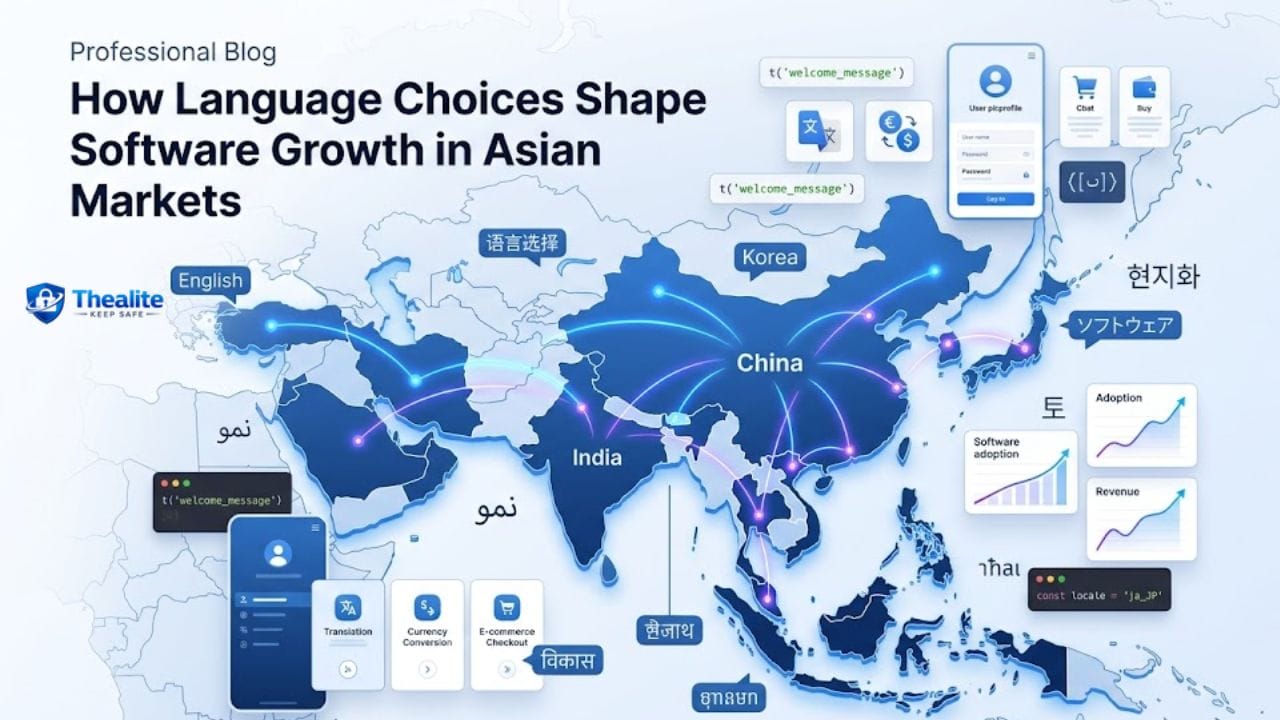
When software companies move into Asia, they expect the same playbook to work across markets. Build the product, translate the interface, push marketing, and scale. On paper, it sounds efficient. In practice, it rarely works that way.
A product that performs well in the US or Europe can lose users in Asian markets even when downloads look strong. The drop doesn’t come from bugs or pricing. It comes from something less visible: the way the product communicates and how customers experience it.
This is where many companies realize they needed a software localization company for Asian languages much earlier in the process, not as a finishing step, but as part of product design from the beginning. By the time they reach that point, the cost of confusion has already surfaced in churn and weak engagement.
Language is not the surface problem.
Most companies assume language issues are simple. They think replacing text and adjusting formatting can work. That assumption breaks quickly in Asia. Languages in this region don’t just translate words; they reshape structure. A short English instruction can expand significantly in Chinese. Japanese can compress ideas into fewer characters but shift tone completely. Korean interfaces often rely on phrasing that carries formality differently than English. The result is not just visual change. It alters how the product feels.
A button label that seems fine in English might feel vague or overly direct in another language. An onboarding message that sounds friendly in one market can come across as careless in another. These are small shifts, but they change how users judge credibility in software within seconds.
The real friction users don’t report
What makes expansion in Asia tricky is that users rarely complain about language issues directly. They don’t send feedback saying “the wording felt off.” They just leave.
That behavior is often misread as a product issue, or worse, a marketing problem. But when you look closer, the pattern is usually the same: users hesitate during onboarding, slow down while exploring features, or abandon the process midway.
The friction is subtle. It shows up as extra cognitive effort. Users are constantly interpreting instead of flowing through the interface. And in markets where alternatives are abundant, that extra effort is enough to lose them. This is why localization is less about translation accuracy and more about reducing mental resistance inside the product.
Why scaling breaks quietly in Asia
A common mistake is assuming that one “Asian version” of a product is enough. It isn’t. The region doesn’t behave as a single market. Even within Southeast Asia, expectations differ widely. Indonesian users may prefer more conversational guidance, while users in Japan tend to respond better to precise, structured messaging. In India, familiarity with English interfaces can shift expectations entirely compared to other regions. When companies ignore these differences, they end up building a neutral tone that doesn’t fully connect anywhere. This strategy is just emotionally flat. That flatness doesn’t stop usage immediately, but it prevents attachment. Users don’t feel like the product belongs to them.
Where most teams miscalculate effort
One recurring issue is timing. Localization is usually introduced after UI, UX, and content decisions are finalized. At that point, language is forced to adapt to structure instead of shaping it.
That creates unnecessary constraints. Text is forced into spaces it doesn’t fit. Instructions lose clarity because they were originally written for a different rhythm. Even navigation flow can feel unnatural because sentence logic doesn’t align with user expectations in another language.
Another overlooked issue is consistency across touchpoints. Marketing pages might be carefully adapted, while in-app messaging stays rigid. Users notice that disconnect immediately. It creates a subtle sense that the product they were promised is not the same as the product they are using.
The silent cost of “good enough” translation
A lot of companies stop at translations that are technically correct. The grammar works. The meaning is preserved. But something still feels off. That “off” feeling is where retention starts to weaken.
In Asian markets, users are highly sensitive to tone. A slight mismatch in phrasing can make an interface feel foreign even when the language is correct. This is especially visible in onboarding flows, error messages, and guidance prompts, places where users form trust quickly.
At scale, this becomes expensive. Acquisition costs rise because conversion drops after download. Support requests increase in regions where clarity is low. Product teams then spend time fixing what appear to be UX issues when the root problem is linguistic alignment.
What better adaptation actually looks like
Stronger localization begins with understanding how users in each market interpret action. For example, in some Asian markets, users prefer guidance that feels supportive and complete rather than minimal. In others, brevity is more effective because users already expect familiarity with digital tools.
When products are adapted properly, the difference is noticeable but not obvious. Users don’t feel like they are using a “localized version.” They feel like the product was designed for them from the start. This is also where a translation service provider plays a different role than people expect. It not only converts text but also acts as a layer of interpretation.
Patterns seen in products that succeed
Products that scale well in Asia tend to share a few quiet habits. They test language inside real usage instead of reviewing it in isolation, and they observe where users pause rather than relying only on surveys. Moreover, they adjust tone based on behavior, not assumption. They also avoid freezing localization at launch. Instead, they keep refining microcopy, onboarding steps, and interface prompts based on how users actually respond over time. What stands out is not perfection, but responsiveness. Language evolves with usage, not before it.
Why language becomes product strategy
At a certain point, companies stop treating localization as a support function and start seeing it as part of product design. That shift changes everything. It affects how features are written, how flows are structured, and even how support systems communicate. In Asia especially, where user expectations vary sharply across regions, this becomes a growth factor rather than an operational task.
Products that ignore this tend to rely heavily on acquisition to compensate for weak retention. Products that address it early build momentum that compounds naturally because users understand the product without friction.
Closing thought
The gap between success and struggle in Asian markets is rarely technical. It is almost always interpretive. Software doesn’t fail because it is incomplete. It fails because users experience it differently than intended.
When language is handled as part of product design—not just translation—the entire experience shifts. Users stop mentally translating and start interacting naturally. That’s when adoption stabilizes, retention improves, and growth becomes less dependent on continuous acquisition. In the end, scaling in Asia is more about making sure nothing gets lost in how those languages are experienced.