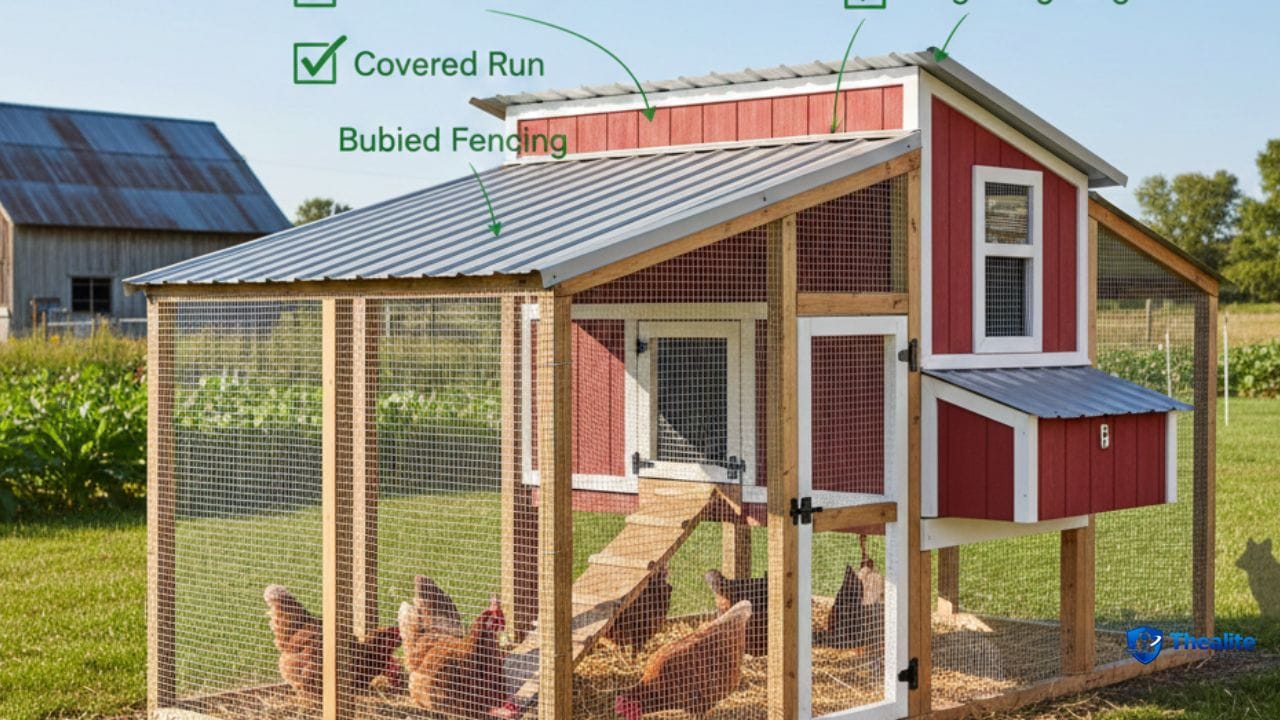
Backyard chickens are fun, productive, and surprisingly vulnerable. The biggest threat isn’t usually disease or cold weather—it’s predators and weak coop security. In many parts of the U.S., flocks face hawks, owls, raccoons, foxes, coyotes, snakes, and roaming dogs (a major backyard risk).
The best chicken safety plan is a **layered system**: a secure coop at night, a strong run, smart daily routines, clean feed practices, and weather readiness. This guide walks you through the highest-impact steps—and ends with a copy/paste checklist.
Quick Answer (The 8 Safety Layers)
- Secure the coop for nighttime (most attacks happen after dark).
- Use hardware cloth for predator resistance (chicken wire is not enough).
- Prevent digging with an apron/skirt around the run.
- Create overhead cover to reduce hawk attacks.
- Free-range only in safe hours; lock up before dusk.
- Store feed sealed and remove leftovers to avoid attracting predators.
- Practice basic biosecurity to reduce disease and parasites.
- Prepare for extreme weather and emergencies (heat, cold, storms).
Step 1: Make Nighttime the Safest Part of the Day
If you do only one upgrade, make your coop night-safe. Raccoons, foxes, owls, and other predators often hunt at night. A weak latch or small gap can turn into a disaster.
What a predator-resistant coop looks like
- Solid walls and roof (no gaps bigger than a finger width).
- Ventilation openings covered with hardware cloth (not chicken wire).
- Strong door that closes flush and can’t be pried open.
- Two-step latches (carabiner/spring clip) that raccoons can’t manipulate easily.
The latch rule (important)
Many predators—especially raccoons—are surprisingly good at opening simple latches. If you can open it with one motion, a raccoon might too. Use latches that require two actions.
Step 2: Build a Run That Predators Respect
A chicken run keeps birds protected during the day and gives you a safe default when you can’t supervise. For real predator protection, **hardware cloth** is the standard choice.
Hardware cloth vs chicken wire (simple difference)
Chicken wire is mainly for keeping chickens *in*. Hardware cloth is stronger and better at keeping predators *out*. If predators are common in your area, use hardware cloth for run walls and vents.
Run essentials
- Hardware cloth on sides and openings.
- A roof or overhead netting (helps with hawks and climbing predators).
- Secure run door latches (same two-step logic).
Stop diggers (foxes, dogs, coyotes)
- Install an apron/skirt of hardware cloth around the perimeter (extends outward underground).
- Or bury fencing to reduce digging access (follow local best practices).
- Check corners regularly—predators test the weakest spot.
Step 3: Reduce Hawk and Owl Risk
Hawks are a common daytime risk, especially for smaller breeds and young birds. You don’t need to eliminate all open space—you need quick cover so birds can hide.
Overhead protection ideas
- Covered run section (best).
- Netting or shade cloth over part of the run/yard.
- Trees, shrubs, or safe ‘hide zones’ like low shelters.
Feeding tip
Feed and treat chickens closer to cover (not in the wide-open center of the yard). It reduces exposure to aerial predators.
Step 4: Smart Free-Range Rules (If You Free Range)
Free-ranging can be safe with rules. The biggest mistake is letting chickens roam all day and expecting luck to do the job.
Safer free-range routine
- Release chickens after full daylight (avoid dawn predator activity).
- Bring them back before dusk—no exceptions.
- Supervise when possible (especially with young birds).
- Have a plan to recall them (treat bucket, consistent call).
Full guide: How to Keep Free Range Chickens Safe.
Step 5: Don’t Attract Predators With Feed, Trash, and Rodents
Predator problems often start with easy food. Spilled feed attracts rodents; rodents attract snakes; and the whole chain attracts bigger predators.
- Store feed in sealed metal or heavy-duty containers.
- Feed during the day and remove leftovers before night.
- Clean spills around feeders quickly.
- Secure trash and compost so raccoons and skunks aren’t drawn in.
Step 6: Weather Safety (Heat, Cold, Storms)
Chickens handle mild cold better than extreme heat, but both require adjustments. Storms can also stress birds and damage coops.
Hot weather safety
- Provide shade and multiple water stations.
- Add ventilation and avoid overcrowding.
- Offer cool water; refresh often during heat waves.
- Watch for heat stress: panting, wings held away, lethargy.
Heat mindset: How to Keep Pets Safe in Hot Weather.
Cold weather safety
- Ventilation matters (moisture buildup causes problems).
- Keep bedding dry; wet bedding increases chill risk.
- Prevent water from freezing (swap often; use safe heaters if needed).
Cold mindset: How to Keep Pets Safe in Cold Weather.
Storm safety
- Secure the coop roof and run panels before storm season.
- Have a plan to lock birds in early if severe weather is coming.
- Keep carriers/crates ready if you must relocate birds.
Emergency planning mindset: How to Keep Pets Safe During a Tornado.
Step 7: Basic Health and Biosecurity (Don’t Skip This)
Predators are the headline risk, but disease and parasites quietly reduce flock health. A simple routine prevents many issues.
Biosecurity basics
- Quarantine new birds before introducing to the flock.
- Keep the coop clean and dry; replace wet bedding quickly.
- Provide a dust bath area (helps birds manage mites).
- Watch for symptoms: lethargy, diarrhea, sneezing, pale comb, weight loss.
Egg safety note
Collect eggs regularly and keep nest boxes clean. Dirty eggs and wet bedding invite bacteria and pests.
Step 8: What to Do After a Predator Attempt
Predators often return once they’ve found a food source. After any attack attempt, assume they will be back.
- Inspect the coop/run for entry points (especially corners and latches).
- Upgrade weak latches and add hardware cloth where needed.
- Temporarily restrict free-ranging and keep birds in a protected run.
- Remove attractants (leftover feed, spilled grain).
Daily Chicken Safety Routine (5 Minutes)
- Morning: quick coop/run check, latch check, water + feed check.
- Midday (optional): hawk scan, confirm shade/water in hot weather.
- Evening: count chickens, lock coop before dusk, remove leftover feed.
Copy/Paste Checklist: Keep Chickens Safe
- Predator-proof coop with strong two-step latches
- Hardware cloth on vents and run (not chicken wire)
- Dig protection (apron/skirt) around run perimeter
- Overhead cover/netting to reduce hawk risk
- Free-range only in daylight; lock up before dusk
- Feed stored sealed; remove leftovers; clean spills
- Clean, dry coop; quarantine new birds; provide dust bath
- Weather plan: shade/water in heat, dry bedding in cold, storm readiness
FAQs
What’s the #1 way to keep chickens safe?
Lock them in a secure, predator-resistant coop every night. Most serious predator attacks happen after dark.
Is chicken wire enough to protect chickens?
Chicken wire mainly keeps chickens in. For predator protection, hardware cloth is stronger and more reliable.
How do I protect chickens from hawks?
Provide overhead cover (netting/shade cloth/trees) and safe hiding zones, and avoid feeding in wide-open areas.
Should I free range chickens if I have coyotes or dogs nearby?
You can, but it requires stronger layers: secure fencing, a protected run, strict daylight-only ranging, and early lock-up.
What should I do if a raccoon tries to open the coop?
Upgrade latches to two-step latches and reinforce weak points. Raccoons are skilled and will return once they’ve found a target.
Conclusion
Keeping chickens safe is mostly about predictable layers: a secure coop at night, a strong run with hardware cloth, dig prevention, overhead cover, and consistent routines. Add smart feed storage, basic biosecurity, and weather readiness, and you’ll reduce losses dramatically while keeping your flock healthy and productive.

As a digital marketer, she has received multiple international awards, including Campaign of the Year at the 2023 European Content Awards and Best Use of Content Marketing at the 2022 Global Search Awards. Nicai holds an MSc in Marketing (First Class Honours) from the UCD Smurfit Graduate Business School and she has also completed the Artificial Intelligence Programme at Oxford University’s Saïd Business School. She is also a contributing writer for publications such as Entrepreneur and Esquire.