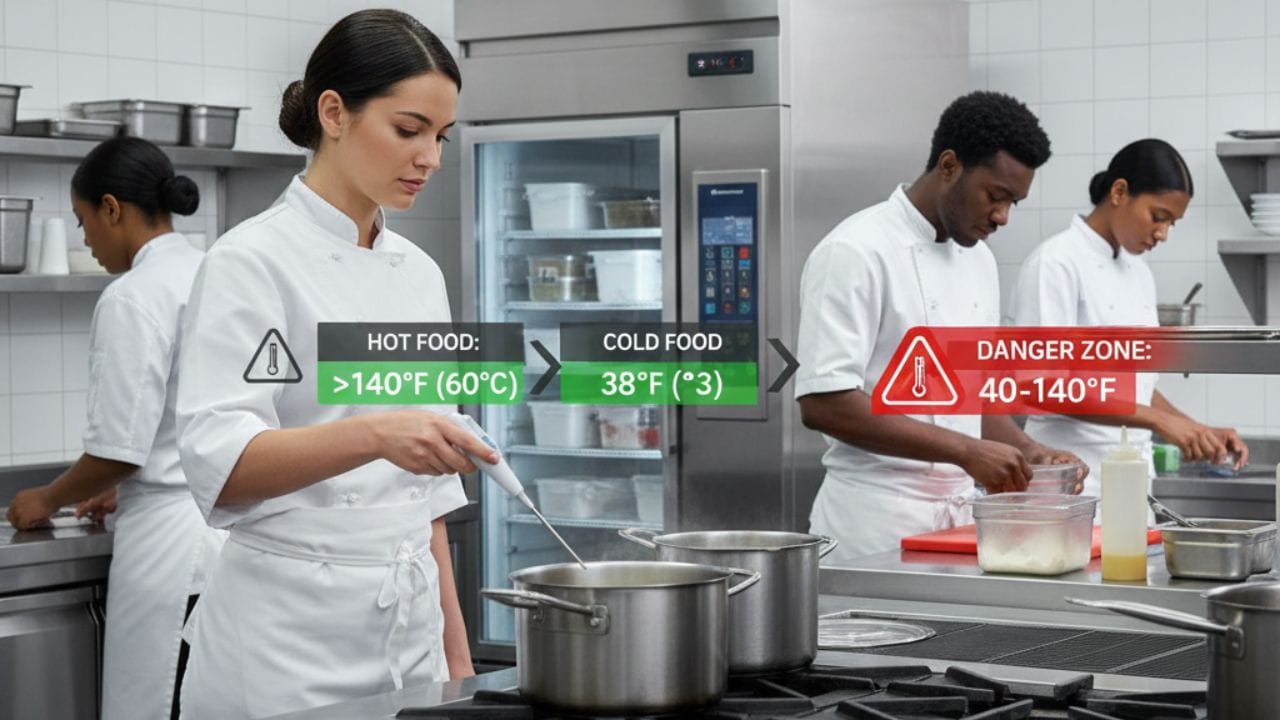
You keep temperature control for safety by keeping foods out of the “danger zone.” Cold foods should stay cold (41°F / 5°C or below), hot foods should stay hot (135°F / 57°C or above), and you should use a thermometer instead of guessing. Temperature + time together decide whether food stays safe.
What “Temperature Control for Safety” Means
Temperature control for safety means controlling how fast bacteria can grow. When food sits too long at warm temperatures, bacteria can multiply quickly.
So your job is simple: keep food cold, keep food hot, and minimize the time in between.
The Danger Zone (What You’re Avoiding)
The “danger zone” is the temperature range where bacteria grow faster. In most food safety training, it’s roughly 41°F to 135°F (5°C to 57°C).
Food becomes risky when it stays in that range too long. That’s why time limits and thermometers matter.
Cold Holding: How to Keep Cold Food Safe
Cold holding means keeping ready-to-eat items, ingredients, and leftovers cold enough while stored or displayed.
Cold holding rules that work:
- Keep cold food at 41°F (5°C) or below.
- Use a fridge thermometer and check the warmest spots (often the door area).
- Don’t overload the fridge—airflow matters.
- Keep lids on containers when possible.
- Return food to the fridge fast after serving.
Related guide: which practices help keep cold food safe.
Hot Holding: How to Keep Hot Food Safe
Hot holding means keeping cooked food hot enough on a steam table, buffet, warmer, slow cooker, or during service.
Hot holding basics:
- Keep hot food at 135°F (57°C) or above.
- Stir foods on warmers so heat stays even.
- Cover pans when you can to hold heat.
- Don’t rely on “it feels hot” — check with a thermometer.
Cooling Food Safely (Where Many People Mess Up)
Cooling is a common problem because big containers cool slowly. If the center stays warm for hours, bacteria can grow.
Better cooling habits:
- Use shallow containers so food cools faster.
- Split big batches into smaller portions.
- Leave space in the fridge so air can circulate.
- Don’t stack hot containers tightly together.
Reheating Safely
Reheating should bring food back to a safe temperature quickly, not slowly.
Simple reheating habits:
- Reheat leftovers until they’re steaming hot.
- Stir soups and sauces so heat is even.
- Don’t reheat with low heat for a long time (that can keep food in the danger zone).
Use a Thermometer (The One Tool That Makes Food Safer)
A food thermometer removes guessing. It helps with cooking, cooling checks, and holding temps.
Easy thermometer routine:
- Check cold holding temps daily (fridge/cooler).
- Check hot holding temps during service.
- Spot-check thick foods like soups, casseroles, and rice dishes.
- Clean the probe between checks (avoid cross-contamination).
Time Rules: How Long Can Food Sit Out?
Even with good temperatures, time matters. A common safety rule is: don’t leave perishable foods out for more than 2 hours. If it’s very hot outside, aim for 1 hour.
If you can’t control temperature, reduce exposure time. That’s the fastest way to lower risk.
Food Worker Notes (If This Is for Training or ServSafe-Style Questions)
In food service, temperature control often includes logging temps, using calibrated thermometers, and following written procedures. Soups and buffets are frequent examples because they can stay warm for long periods.
Related training-style guide: what are food workers required to keep soup safe.
Common Mistakes That Break Temperature Control
These mistakes show up at home and in restaurants:
- Leaving food out to “cool down” for hours
- Keeping big batches in deep containers
- Overfilling the refrigerator
- Using warmers that don’t hold safe temps
- Not stirring soups/sauces on hot holding
- Skipping thermometer checks
Quick Checklist: Keep Temperature Control for Safety (Food Safe)
- Cold foods: 41°F (5°C) or below
- Hot foods: 135°F (57°C) or above
- Avoid the danger zone (41–135°F) as much as possible
- Cool fast using shallow containers and smaller portions
- Reheat thoroughly and stir thick foods
- Use a thermometer and check temps regularly
FAQs
What does “temperature control for safety” mean?
It means controlling food temperature so bacteria can’t grow quickly. Keep foods out of the danger zone by holding cold foods cold and hot foods hot.
What temperature should cold food be held at?
A common standard is 41°F (5°C) or below.
What temperature should hot food be held at?
A common standard is 135°F (57°C) or above.
What’s the best way to cool food safely?
Use shallow containers, split large batches, and get food into the fridge quickly so it cools fast through the danger zone.
Do I really need a thermometer?
Yes. Thermometers prevent guessing and help you catch problems before food becomes unsafe.
More “Keep Safe” Guides
Explore more food safety topics at Thealite Keep Safe.

As a digital marketer, she has received multiple international awards, including Campaign of the Year at the 2023 European Content Awards and Best Use of Content Marketing at the 2022 Global Search Awards. Nicai holds an MSc in Marketing (First Class Honours) from the UCD Smurfit Graduate Business School and she has also completed the Artificial Intelligence Programme at Oxford University’s Saïd Business School. She is also a contributing writer for publications such as Entrepreneur and Esquire.