If you have ever seen photos of a modern car after a severe accident, you might be shocked to see the front end completely crushed and unrecognizable while the passenger cabin remains remarkably intact. To the untrained eye, a smashed front bumper might look like a sign of cheap manufacturing or weak materials. In reality, this is one of the most successful, life-saving engineering achievements in automotive history. Decades ago, cars were built to be entirely rigid and unyielding, which meant the brutal force of a collision was transferred directly into the bodies of the passengers. Today, vehicle safety revolves around the brilliant science of energy management and controlled destruction.
What Crumple Zones Are
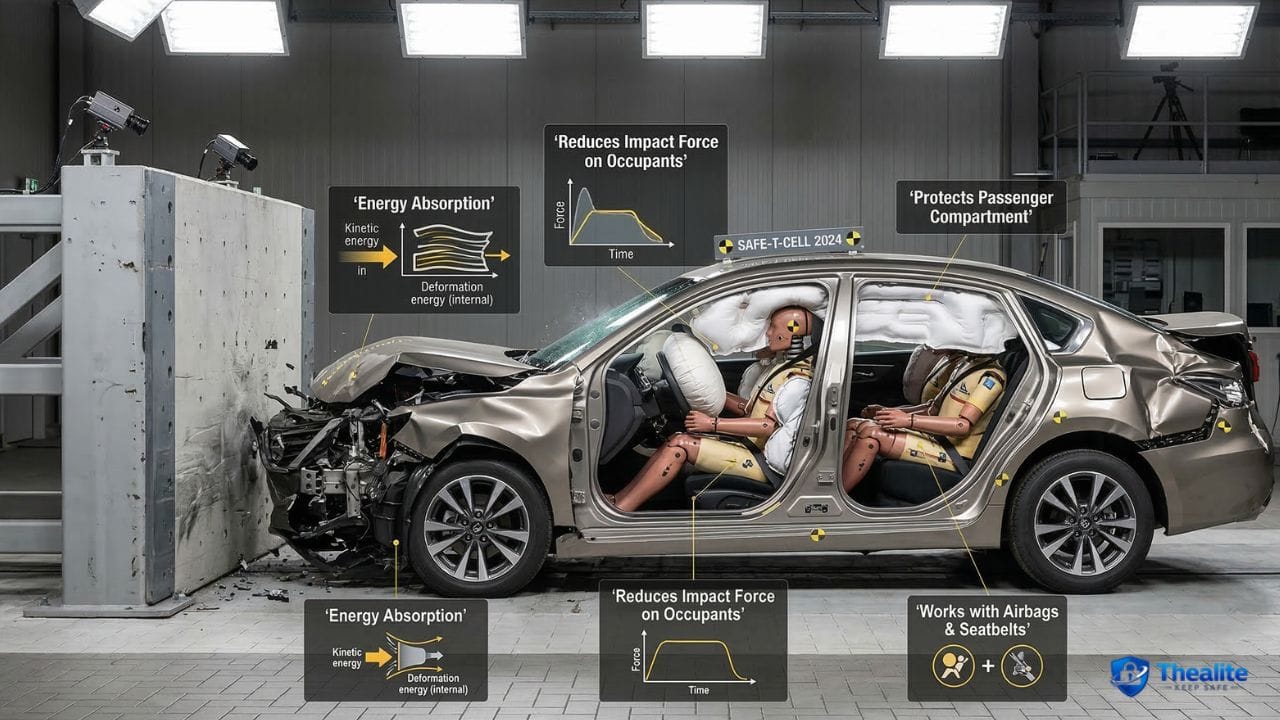
Crumple zones, sometimes called crush zones, are specific structural areas located primarily at the front and rear of a vehicle. These sections are deliberately engineered to deform, fold, and crush during a collision. Instead of using solid, unyielding blocks of steel, automotive engineers use specialized materials and strategically placed geometric patterns—like holes, dimples, and varied metal thicknesses—to create a frame that acts like a massive accordion when it strikes a solid object.
How Do Crumple Zones Keep You Safe in a Crash?
If you are wondering how do crumple zones keep you safe, the answer lies in simple physics. During a crash, a massive amount of kinetic energy is generated. That energy has to go somewhere. If a car is completely rigid, it stops instantly, and the energy passes straight through the frame and into the driver. Crumple zones solve this by increasing the time it takes for the vehicle to come to a complete stop. By crushing inward, they stretch a fraction-of-a-second impact into a slightly longer event. This deceleration drastically reduces the violent peak force that reaches the human body, turning a potentially lethal jolt into a survivable impact.
How Crash Energy is Absorbed and Redirected
The goal is to keep energy away from the people inside. As the front of the car crushes, the metal frame absorbs the kinetic energy by bending and breaking. Engineers design the frame to channel any remaining impact force around the passenger cabin—down through the floorboards and across the roofline—rather than straight through the dashboard.
Crumple Zones vs. The Stronger Passenger Cabin
For crumple zones to work, the center of the car must be entirely different. The area where the driver and passengers sit is known as the “safety cell.” Unlike the front and rear, this cabin is built from ultra-high-strength steel designed to resist bending at all costs. Think of it like a protective lockbox. Just as you might figure out how to keep moisture out of a safe or wonder can you keep cash in a safe deposit box to protect your physical wealth, car manufacturers build an armored “vault” in the middle of the vehicle to protect your physical health.
How Seat Belts and Airbags Work With Crumple Zones
No safety feature works alone. Crumple zones slow down the vehicle, but if the occupants are not wearing seat belts, they will continue moving forward at the original speed of the car. Seat belts catch the passengers and tie them to the deceleration of the safety cell. Simultaneously, airbags deploy to cushion the final impact of the head and chest. These three systems—crumple zones, seat belts, and airbags—must work together in perfect harmony to ensure survival.
Why Modern Car Design Uses Controlled Deformation
Older cars built in the 1950s and 1960s were heavy, stiff, and often bounced off objects during an accident. Bouncing is incredibly dangerous because the sudden change in direction puts extreme stress on the brain and internal organs. Modern cars do not bounce; they absorb the hit. Controlled deformation sacrifices the machinery of the car to preserve the fragile human biology inside.
Common Myths About Car Crash Safety
The most persistent myth in automotive safety is that “older cars were built like tanks and were much safer.” While an older car might suffer less cosmetic damage in a fender bender, it performs terribly in a high-speed crash. A stiff frame forces the passengers to absorb the shock. A destroyed modern car is not a failure; it is visual proof that the vehicle sacrificed itself to absorb the energy, exactly as it was designed to do.
What Crumple Zones Can and Cannot Do
While this engineering is brilliant, it has limitations. Crumple zones are highly effective in front and rear collisions, but side impacts (T-bone crashes) offer very little space for metal to crumple, relying instead on side airbags and rigid door beams. Furthermore, even the best engineering cannot defy the laws of physics at extreme, excessive speeds.
Being prepared on the road involves multiple layers of safety. While the car protects your body, you must also rely on your own habits to secure your life. For instance, when taking a cross-country trip, you need to know how to keep your money safe while traveling in case of a breakdown. When parked, it is your responsibility to understand how to keep your car safe from theft so your protective vehicle isn’t stolen. And if you are ever in an accident, having quick access to your insurance policies is vital, which is why figuring out how to keep important documents safe at home in a designated folder saves immense stress during the claims process.
Why Understanding Safety Design Matters for Drivers and Families
Understanding how a vehicle keeps you safe helps you become a better, more informed driver. It reminds us why wearing a seat belt is non-negotiable—because the entire engineering of the car is built around keeping a restrained passenger safe inside the rigid cabin. Recognizing the value of modern safety features can also help families make smarter decisions when purchasing a new or used vehicle for young drivers, prioritizing advanced crash-energy management over cosmetic appeal.
Frequently Asked Questions (FAQ)
How do crumple zones keep you safe?
Crumple zones keep you safe by absorbing the kinetic energy of a crash. By intentionally crushing and folding, they slow down the vehicle’s deceleration time, which drastically reduces the violent impact force that is transferred to the passengers inside.
What is a crumple zone in a car?
A crumple zone is a specific structural area at the front or rear of a vehicle that is engineered to deform and crush like an accordion during a collision, acting as an energy-absorbing cushion.
Do crumple zones make a car weaker?
No. While the outer extremities are designed to crush, the central passenger cabin is built from ultra-high-strength steel. Crumple zones make the overall car significantly safer by managing energy, not by weakening the frame where people sit.
Do airbags and seat belts work with crumple zones?
Yes, they are a combined system. Crumple zones slow the car down, seat belts tie the passengers to that slower deceleration, and airbags provide the final soft barrier to prevent heads and chests from striking the hard interior.
Are crumple zones in the front and back of a car?
Yes, modern vehicles feature crumple zones in both the front end (to protect against head-on collisions) and the rear end (to protect against rear-end collisions).
Can crumple zones prevent all injuries?
No. While they greatly reduce the severity of injuries, they cannot defy physics at extreme, excessive speeds. They also offer limited protection in side-impact crashes where there is little physical space to create a crush zone.
Why do cars crumple in an accident?
Cars crumple intentionally because engineers score and shape the metal to fold under pressure. This controlled destruction absorbs the shock of the crash so the human bodies inside the car do not have to.
Are newer cars safer because of crash design?
Yes, newer cars are exponentially safer than older cars precisely because of advanced crash design. Modern energy management systems ensure that the vehicle sacrifices itself to protect the occupants inside.

As a digital marketer, she has received multiple international awards, including Campaign of the Year at the 2023 European Content Awards and Best Use of Content Marketing at the 2022 Global Search Awards. Nicai holds an MSc in Marketing (First Class Honours) from the UCD Smurfit Graduate Business School and she has also completed the Artificial Intelligence Programme at Oxford University’s Saïd Business School. She is also a contributing writer for publications such as Entrepreneur and Esquire.