Stairs are one of the most common places for slips, trips, and falls—especially in workplaces where people move quickly, carry items, or use stairways repeatedly throughout the day. A handrail seems simple, but it’s one of the most effective fall‑prevention tools you can install.
In plain terms: handrails keep you safe by giving you a stable handhold. That handhold lets you catch yourself when you slip, steady your balance on the way down, and maintain control when you’re tired, distracted, or carrying something.
This guide explains how handrails reduce injuries, what “good” handrails look like in real life, and what OSHA generally expects for stair handrails and stair rail systems in U.S. workplaces.
Related reading on your site: How Handrails on Stairs Help Keep You Safe • How Will These Rules Keep You Safe? • How to Keep Your Home Safe
Quick Answer
Handrails on stairs help keep you safe by providing a reliable handhold that improves balance, reduces slips from turning into falls, and helps you control your body during sudden missteps. In OSHA‑regulated workplaces, properly installed handrails and stair rail systems are a key part of stair safety—especially on stairways with multiple risers or unprotected edges.
Why Stairs Are Risky (Even for Careful People)
Stairs combine multiple fall factors at once: changing elevation, smaller foot placement areas, and the need to shift weight forward or downward. Common workplace contributors include:
- Wet or dusty treads (rain, snow, spills, construction dust)
- Poor lighting or shadows on steps
- Carrying tools, boxes, or supplies (reduced visibility and balance)
- Rushing and distraction (phones, conversations, multitasking)
- Uneven step height or damaged stair nosing
- Clutter on or near stairs (trip hazards)
How Handrails Actually Prevent Injuries
Handrails prevent injuries in several practical ways:
1) They give you a recovery point when you slip
Most stair falls start as a small slip: a foot lands slightly wrong or the tread is slick. A handrail provides an immediate recovery point so you can catch yourself before a slip becomes a fall.
2) They reduce the effect of carrying loads
When workers carry items, they often can’t see every step and their center of gravity shifts. A handrail gives extra stability—especially when turning on landings or stepping down.
3) They improve confidence and pace control
People tend to move more safely on stairs when they have a dependable handrail. It encourages controlled speed and reduces risky quick-stepping behavior.
4) They help in emergencies
During evacuations or alarms, stairs can become crowded. Handrails guide movement and reduce collisions and falls.
OSHA Basics: Handrails vs Stair Rail Systems
OSHA uses specific terms. While details can vary between general industry and construction rules, the key idea is the same:
• A handrail is meant to be grasped for support.
• A stair rail system helps protect the open side/edge of stairs and can include a top rail plus intermediate members.
In many newer general-industry setups, the handrail and the top rail of the stair rail system may need to be separate.
OSHA Height Concepts (Simple Explanation)
OSHA requirements include height ranges for handrails and stair rail systems. Exact measurement points matter (often measured from the leading edge of the tread). A simplified way to think about it:
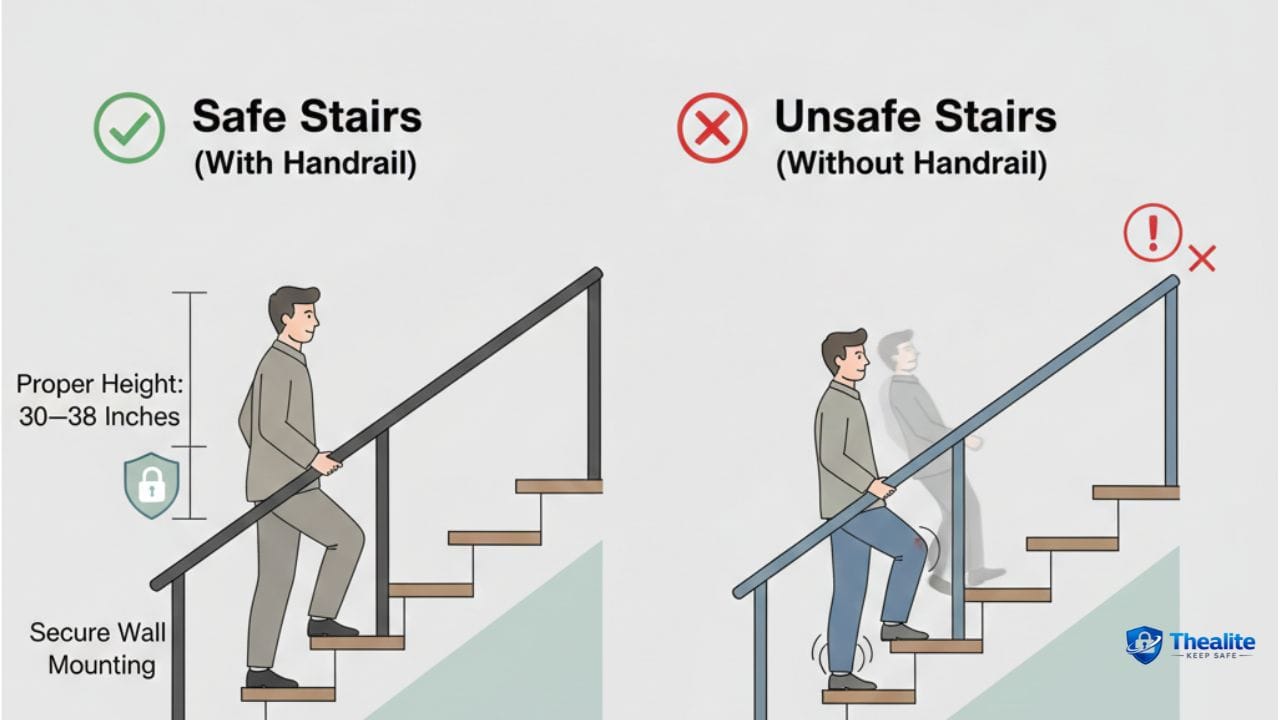
• Handrails are typically around 30–38 inches high in general-industry rules.
• Stair rail system top rails in newer general-industry systems are often 42 inches or higher, with a separate handrail.
• Construction rules also define stairrail and handrail height ranges.
Because requirements can differ by context and installation date, employers should verify which OSHA standard applies to their stairway.
What OSHA Looks For in a Good Handrail
Beyond just having a rail, OSHA’s criteria focus on whether it can actually prevent falls. A good handrail is:
Graspable and continuous
- Easy to grip with a full hand (not too wide or awkward)
- Continuous along the stair run where people need support
- Placed where users naturally reach when ascending/descending
Strong and stable
- Doesn’t wobble or flex under normal force
- Securely anchored at mounts/brackets
- Able to withstand significant load without failure (OSHA includes strength criteria)
Free of snag and projection hazards
- Ends don’t create sharp projection hazards
- Surface is smooth enough to prevent cuts/snags
- No splinters, sharp edges, or broken brackets
Clearance from walls/obstructions
Handrails need enough clearance from walls and other objects so users can wrap fingers around the rail and slide their hand along it.
Common Stair Handrail Problems That Create Risk
- Handrail ends that stop too early (gap where support is needed)
- Loose brackets or wobbly rails
- Handrails blocked by stored items, signage, or equipment
- Damaged treads/nosing (rail can’t compensate for broken steps)
- Poor lighting that makes people miss steps and handholds
- Rails that are too wide, too slick, or not graspable
Workplace Stair Safety Checklist (OSHA-Style, Practical)
Use this checklist to spot issues quickly:
- Handrail is present where needed and runs the usable length of the stairs
- Rail is sturdy (no wobble) and mounts are tight
- Rail is graspable and comfortable to hold
- Rail is at an appropriate height for the environment and code context
- Adequate clearance between rail and wall/objects
- No sharp edges, splinters, or projection hazards at ends/brackets
- Steps are even and in good repair (no broken nosings, loose treads)
- Non-slip surfaces are in place (especially in wet/industrial areas)
- Stairway lighting is sufficient (no dark zones)
- Edges/open sides have appropriate protection (stair rail system/guarding)
Training: How to Teach Workers to Use Handrails
Even perfect handrails won’t help if people don’t use them. Short training reminders can reduce falls.
Simple training points
- Use the handrail every time—especially when descending.
- Don’t run on stairs; keep one hand free when possible.
- Keep eyes on the stairs (avoid phone use on stairways).
- Report loose rails, damaged steps, or lighting issues immediately.
- Carry loads so one hand can still reach the rail (or use a cart/lift when available).
Handrails vs Rules: Why Both Matter
Safety works best when engineering controls (like handrails) and behavior rules work together. Handrails reduce risk even when humans make mistakes—but rules reduce the number of mistakes in the first place.
Related: How Will These Rules Keep You Safe?.
FAQs
Does OSHA require handrails on stairs?
OSHA standards address handrails and stair rail systems for workplace stairs. Requirements depend on whether you’re in general industry or construction, the stair configuration, and whether there are unprotected sides/edges.
Why does OSHA focus so much on handrails?
Because falls on stairs are common, and a reliable handhold prevents many slips from turning into injuries. Handrails are a low-cost, high-impact control.
What makes a handrail unsafe?
Loose rails, poor grip shape, sharp edges, blocked access, missing sections where support is needed, and inadequate clearance from walls.
Are stair rails and handrails the same thing?
Not always. A handrail is meant to be grasped for support. A stair rail system protects open sides/edges and may include a top rail plus intermediate members.
What else should I check besides the handrail?
Step condition, slip resistance, lighting, clutter, and whether open edges are properly protected. A good handrail can’t compensate for broken steps or slick surfaces.
Conclusion
Handrails keep people safe on stairs by giving a reliable handhold—something you can grab instantly to prevent a slip from becoming a fall. In OSHA‑regulated workplaces, properly installed and maintained handrails and stair rail systems are a core part of fall prevention. Combine sturdy, graspable rails with good lighting, non-slip steps, and simple training reminders, and you’ll reduce stairway injuries.

As a digital marketer, she has received multiple international awards, including Campaign of the Year at the 2023 European Content Awards and Best Use of Content Marketing at the 2022 Global Search Awards. Nicai holds an MSc in Marketing (First Class Honours) from the UCD Smurfit Graduate Business School and she has also completed the Artificial Intelligence Programme at Oxford University’s Saïd Business School. She is also a contributing writer for publications such as Entrepreneur and Esquire.