Seat belts are one of the simplest safety devices in a car—and also one of the most powerful. They work quietly in the background, but in a crash they do three life-saving jobs: (1) keep you from being thrown around or ejected, (2) spread crash forces across stronger parts of your body, and (3) keep you in the right position so airbags can protect you correctly.
This U.S.-focused guide explains how seat belts keep you safe, what actually happens to the body in a crash, how modern seat belt systems work (pretensioners and force limiters), and how to wear a seat belt correctly. You’ll also get a checklist you can copy/paste.
Quick Answer
Seat belts keep you safe by restraining your body so you don’t slam into the dashboard/windshield, by distributing crash forces across your chest, pelvis, and shoulder, and by keeping you positioned for airbags to work properly. They also reduce the risk of ejection from the vehicle, which is one of the most deadly outcomes in crashes.
What Happens in a Crash (Simple Physics)
In a sudden stop, the car slows down fast—but your body wants to keep moving at the same speed it was going. That’s inertia. Without a seat belt, your body continues forward until something stops it: the steering wheel, dashboard, windshield, or the road outside the car.
Without a seat belt, common injury paths include:
- Head and face impact with the windshield or pillar
- Chest impact with the steering wheel or dashboard
- Knees and hips slamming into the dash (leg/hip injuries)
- Being thrown into other passengers
- Ejection from the vehicle
Seat belts change the story by stopping you gradually and in the right direction.
The 3 Main Ways Seat Belts Protect You
1) They keep you inside the “survival space”
Cars are designed with a protective space around the seat. Seat belts keep you in that space instead of sending you into hard surfaces or out of the vehicle.
2) They spread force across stronger body areas
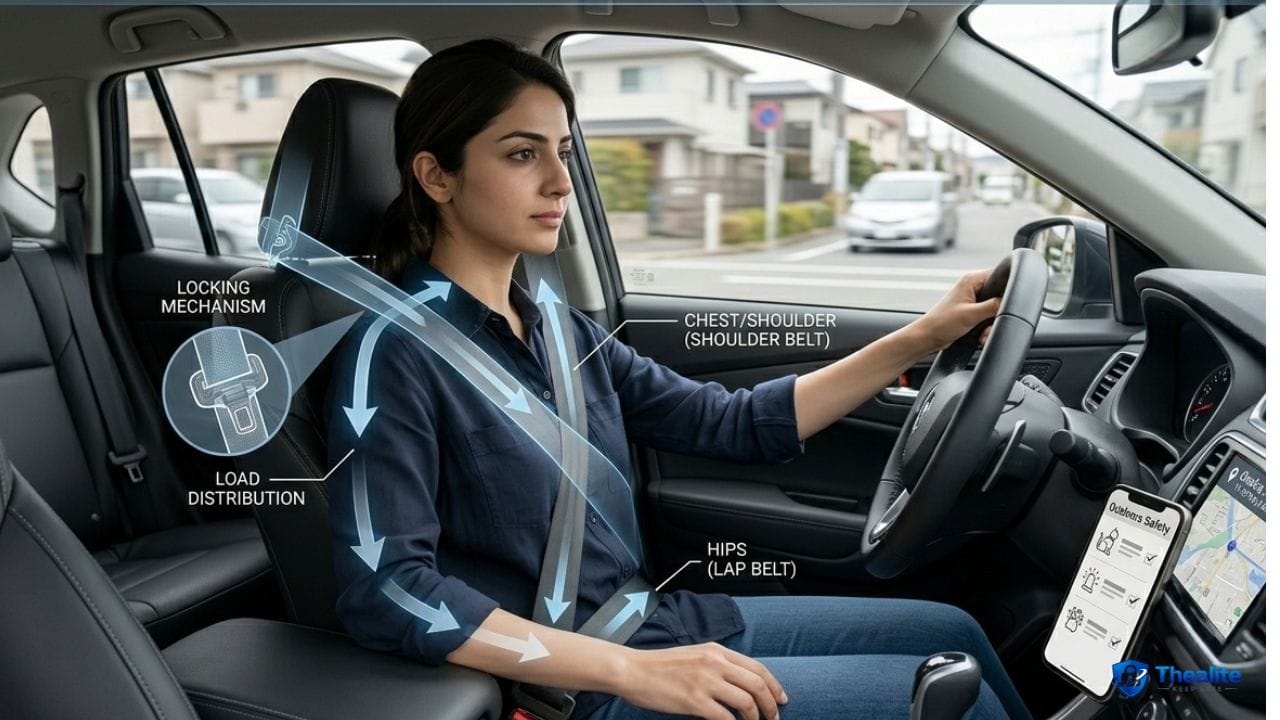
A lap-and-shoulder belt spreads force across the pelvis, chest, and shoulder—areas that can handle force better than the face or abdomen.
3) They help airbags work correctly
Airbags are designed to work *with* seat belts, not instead of them. The seat belt keeps you in position so the airbag cushions your head and chest the way it’s intended. Without a seat belt, you can move forward too fast and too far, and an airbag can’t protect you properly.
How Modern Seat Belts Work (Pretensioners + Force Limiters)
Many modern cars use additional seat belt technology to reduce injury:
Pretensioners
Pretensioners tighten the belt instantly at the start of a crash, removing slack so you’re restrained sooner.
Force limiters
Force limiters allow a small amount of controlled belt ‘give’ to reduce chest pressure while still restraining you.
Together, these features help seat belts restrain you quickly without applying excessive force.
Seat Belts Reduce Ejection Risk (Why This Matters)
Ejection—being thrown out of the vehicle—is extremely dangerous. Seat belts are the primary defense against ejection in most passenger vehicles. Even a minor crash can eject an unbelted passenger if a door opens or a window breaks.
How to Wear a Seat Belt Correctly
Seat belts only work well if they fit correctly.
Lap belt placement
- Place the lap belt low across the hips/pelvis (not across the stomach).
- A lap belt across the belly can increase injury risk in a crash.
Shoulder belt placement
- Shoulder belt should cross the middle of your chest and rest on your shoulder.
- Never put the shoulder belt behind your back or under your arm.
- Adjust the shoulder belt height (if your car allows) so it fits comfortably.
Seat position matters
- Sit upright with your back against the seat.
- Avoid reclining too far (it can change belt fit and increase risk).
- Keep some distance from airbags (especially for drivers), but remain able to control the car safely.
Common Seat Belt Mistakes (And Why They’re Risky)
- Shoulder belt behind the back (removes upper-body protection).
- Shoulder belt under the arm (can injure ribs and internal organs).
- Lap belt over the stomach (increases abdominal injury risk).
- Too much slack (body moves farther before restraint).
- Reclining too far (“submarining” risk—sliding under the belt).
- Sharing one seat belt (not safe; each person needs their own restraint).
Kids and Seat Belts (Booster Seats Matter)
Children aren’t just small adults—seat belts are designed for adult body proportions. If a child is too small, the belt may sit on the neck or stomach instead of the shoulder and hips. That’s why booster seats are used until a child fits the seat belt properly.
Practical parent rules
- Use the correct child restraint for your child’s age, height, and weight (per the seat and vehicle instructions).
- Don’t rush the move to an adult belt—fit matters more than age.
- Teach kids not to put the shoulder belt behind their back for comfort.
More family safety: How to Keep Your Child Safe.
Seat Belts and Pregnant Passengers
Seat belts are still important during pregnancy. The key is correct placement: lap belt low across the hips and under the belly, and shoulder belt across the chest and to the side of the belly. If you have questions, ask a healthcare provider for guidance.
Copy/Paste Checklist: Seat Belt Safety
- Buckle up every ride—driver and all passengers
- Lap belt low on hips/pelvis (not on stomach)
- Shoulder belt across chest and shoulder (not under arm/behind back)
- Sit upright; avoid heavy reclining
- Remove slack; belt snug but comfortable
- Kids use proper car seats/boosters until belt fits correctly
FAQs
Do airbags replace seat belts?
No. Airbags are designed to work with seat belts. Without a belt, you can move out of position and be injured by the airbag or the car interior.
Why is the lap belt supposed to sit low?
Low placement across the hips/pelvis helps distribute force to stronger bones. A belt across the stomach can increase abdominal injury risk.
Can seat belts cause injuries?
Yes, bruises or belt marks can happen, but the injuries are typically far less severe than the injuries from being unrestrained or ejected.
Why is it unsafe to put the shoulder belt behind your back?
It removes upper-body restraint. Your head and chest can strike the steering wheel, dashboard, or windshield.
When can kids use the adult seat belt?
When the belt fits properly: shoulder belt on the shoulder (not neck) and lap belt low on the hips (not belly). Many kids need boosters until they fit correctly.
Conclusion
Seat belts keep you safe by controlling your movement in a crash: they keep you in the survival space, spread force across stronger body areas, prevent ejection, and let airbags work correctly. The best seat belt is the one you actually wear—every ride, every seat—and wear it the right way so it can do its job.

As a digital marketer, she has received multiple international awards, including Campaign of the Year at the 2023 European Content Awards and Best Use of Content Marketing at the 2022 Global Search Awards. Nicai holds an MSc in Marketing (First Class Honours) from the UCD Smurfit Graduate Business School and she has also completed the Artificial Intelligence Programme at Oxford University’s Saïd Business School. She is also a contributing writer for publications such as Entrepreneur and Esquire.