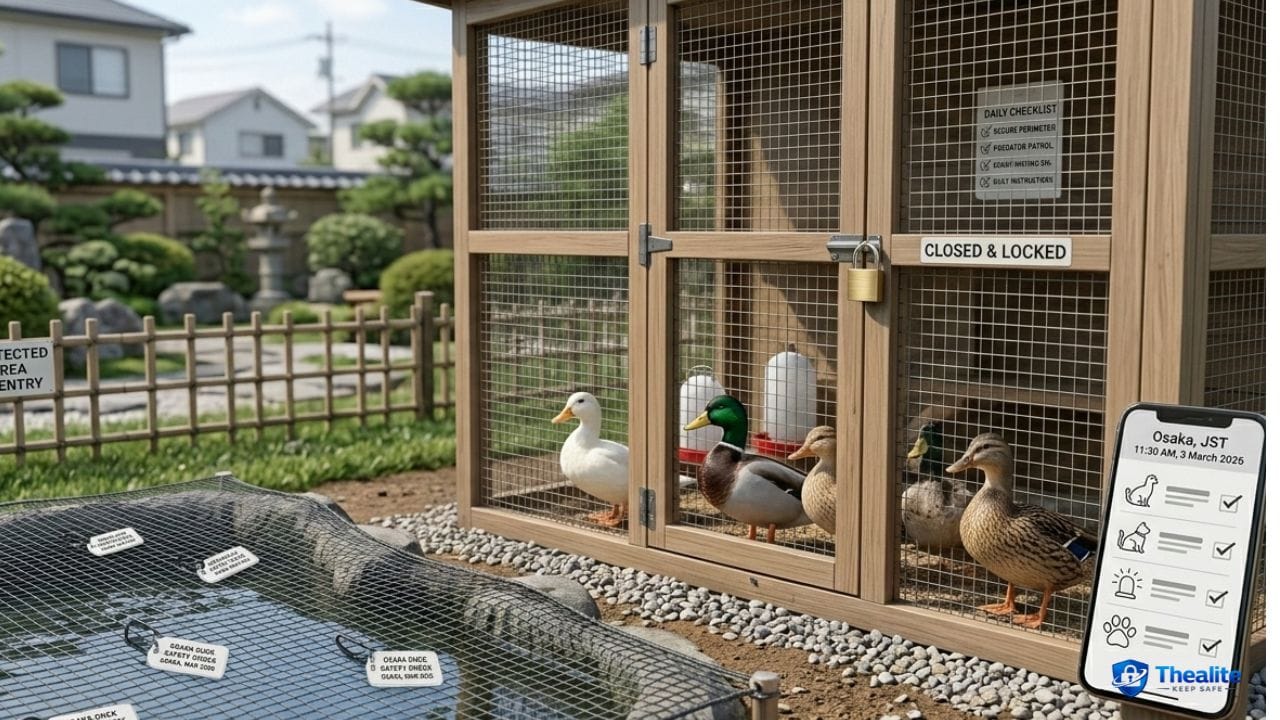
Ducks are hardy, funny, and surprisingly tough—but they’re also a favorite target for predators. In many parts of the U.S., backyard ducks face raccoons, foxes, coyotes, dogs, bobcats, mink/weasels, snakes (for eggs/ducklings), and birds of prey like hawks and owls.
The key to duck safety isn’t one magic gadget. It’s a system secure housing at night, predator-proof fencing, smart routines around ponds, and reducing attractants that bring predators close.
Quick Answer (Duck Predator Protection in 8 Steps)
- Lock ducks in a secure coop at night (most attacks happen after dark).
- Use hardware cloth—not chicken wire—for predator-proof walls and windows.
- Secure the run with a roof or netting to stop hawks and climbing predators.
- Bury an apron of hardware cloth around the run to stop digging predators.
- Use strong latches (raccoons can open simple hooks).
- Reduce attractants: clean feed spills, secure trash, don’t leave food out overnight.
- Make pond areas safer with escape ramps, vegetation cover, and supervised time when possible.
- After any predator sign/attempt, upgrade weak points immediately and reset routines.
Know Your Duck Predators (So You Build the Right Defense)
Predators attack in different ways. The best protection targets the most common threats:
Night predators (most common)
- Raccoons (smart hands; can open latches; reach through wire to grab birds).
- Foxes and coyotes (dig, pull, and pressure weak fencing).
- Dogs (fast attacks; can kill multiple birds quickly).
- Mink/weasels (small; slip through gaps; deadly to poultry).
- Owls (night hunting; can grab smaller ducks/ducklings).
Day predators
- Hawks (especially for ducklings and smaller breeds).
- Loose dogs and neighborhood cats (mostly for ducklings).
- Snakes (mostly eggs and ducklings in some regions).
Core lesson: If you protect against raccoons + digging predators + aerial predators, you eliminate most backyard losses.
Step 1: Nighttime Lock-Up Is Non-Negotiable
If you only do one thing, do this lock ducks in a secure coop every night. Free-ranging ducks overnight dramatically increases losses.
- Train ducks to return at dusk using a consistent routine and a small feeding cue.
- Close and latch the coop door before it’s fully dark.
- Use a secure door and latches that a raccoon can’t open.
Step 2: Build a Predator-Proof Coop (Hardware Cloth Wins)
Chicken wire is meant to keep chickens in—not to keep predators out. For predator protection, use hardware cloth (welded wire mesh) on openings.
Coop security essentials
- Cover all windows/vents with hardware cloth secured with screws + washers (not just staples).
- Check for gaps larger than you think (small predators squeeze through).
- Use solid walls or reinforced panels where possible.
- Make the door frame tight and strong; predators exploit weak corners.
Raccoon-proof latches
- Use carabiners, spring clips, or two-step latches.
- Avoid simple hook-and-eye latches (raccoons can learn them).
- Use two latches on large doors to prevent prying.
Step 3: Predator-Proof the Duck Run (Digging Is the #1 Break-In Method)
Foxes and coyotes often dig under fencing. To stop this, you need an underground barrier.
Best anti-dig methods
- Hardware cloth ‘apron’: extend 12–24 inches outward from the run perimeter and secure it to the ground.
- Bury hardware cloth vertically 12 inches down (more labor, strong barrier).
- Add heavy rocks/pavers along the edge (helps but don’t rely on it alone).
Run fencing tips
- Use stronger welded wire for runs; reinforce lower sections.
- Avoid leaving gaps at gates—gates are common weak points.
- Check corners and seams (predators pry there first).
Step 4: Add a Roof or Netting (Stop Hawks and Climbers)
An open-top run is vulnerable to hawks and owls, and even climbing predators. A covered run also reduces stress because ducks feel safer.
- Use a solid roof, welded wire, or heavy-duty netting designed for livestock protection.
- Cover the entire run—not just part of it.
- If using netting, keep it tight so birds don’t tangle and predators can’t push through.
Step 5: Pond and Water Safety (Water Can Attract Predators)
Ducks love water, but ponds can also attract predators. You can still keep a pond—just manage it wisely.
Safer pond habits
- Supervise pond time if predators are common in your area.
- Provide escape ramps (so ducks can exit quickly and safely).
- Add vegetation cover around edges (ducks can hide; avoid creating ambush zones close to the house).
- Avoid leaving feed near the pond (attracts wildlife).
More pond-specific tips: How to Keep Ducks Safe on a Pond.
Step 6: Reduce Predator Attractants (Don’t Feed the Predators)
Predators visit where food is easy. Your yard can accidentally become a predator buffet.
- Clean up spilled feed daily (rodents attract larger predators).
- Store feed in sealed metal bins with tight lids.
- Don’t leave food outside overnight.
- Secure trash and compost.
- Pick up eggs daily (reduces snake/rat attraction).
Step 7: Use Layers (Lights, Cameras, and Deterrents)
Physical barriers are the main protection. Deterrents add extra layers—especially during high-risk seasons.
- Motion-activated lights near coop/run areas (helps discourage some predators).
- Cameras help you identify the predator and upgrade the right weak spot.
- Motion sprinklers can deter some wildlife in certain setups.
- A livestock guardian dog can work on rural properties (requires training and suitability).
Step 8: What to Do After a Predator Attack or Attempt
If you had an attack, assume the predator will return. Your next steps matter.
- Secure surviving ducks immediately (lock-up and reinforce).
- Inspect the coop/run for entry points (digging, latch failure, roof gaps).
- Upgrade weak points with hardware cloth, stronger latches, and apron barriers.
- Consider adding a temporary secondary fence or covered area.
- If ducks are injured, contact a veterinarian experienced with poultry if possible.
Common Mistakes That Get Ducks Killed
- Using chicken wire as predator protection (it isn’t).
- Leaving ducks out at night.
- Open-top runs in hawk/owl areas.
- Weak latches that raccoons can open.
- Not addressing digging (no apron or buried barrier).
- Leaving food out overnight (invites predators and rodents).
Copy/Paste Checklist: Keep Ducks Safe From Predators
- Ducks locked in a secure coop every night (before dark)
- Hardware cloth on all openings; secured with screws + washers
- Raccoon-proof latches (two-step or carabiners)
- Predator-proof run: strong fencing + hardware cloth apron or buried barrier
- Run covered (roof/welded wire/netting) to block hawks and climbers
- Feed stored in sealed bins; spills cleaned; no food left out overnight
- Pond time supervised if needed; escape ramps added; no feed near water
- After predator sign: inspect, patch weak points, add deterrent layers
FAQs
What is the biggest predator threat to ducks at night?
In many areas, raccoons, foxes, and coyotes are the biggest threats. Raccoons are especially dangerous because they can open simple latches and reach through weak wire.
Is chicken wire enough to protect ducks?
No. Chicken wire is designed to keep birds in, not predators out. Use hardware cloth or strong welded wire for predator protection.
How do I stop predators from digging under a duck run?
Install a hardware cloth apron extending outward 12–24 inches around the run perimeter, or bury hardware cloth vertically to create an underground barrier.
How do I protect ducklings from hawks?
Use a covered run (netting or wire roof), provide overhead cover, and supervise outdoor time—ducklings are high-risk targets.
Should ducks sleep on water to avoid predators?
Some ducks do, but it’s not a reliable protection in backyard settings. A secure coop and run is usually safer and more controllable.
Conclusion
To keep ducks safe from predators, rely on layers: lock-up at night, hardware cloth instead of chicken wire, strong latches, anti-dig barriers, and a covered run. Reduce predator attractants and manage pond areas wisely. Once the system is in place, duck safety becomes routine—and routine is what prevents most losses.

As a digital marketer, she has received multiple international awards, including Campaign of the Year at the 2023 European Content Awards and Best Use of Content Marketing at the 2022 Global Search Awards. Nicai holds an MSc in Marketing (First Class Honours) from the UCD Smurfit Graduate Business School and she has also completed the Artificial Intelligence Programme at Oxford University’s Saïd Business School. She is also a contributing writer for publications such as Entrepreneur and Esquire.