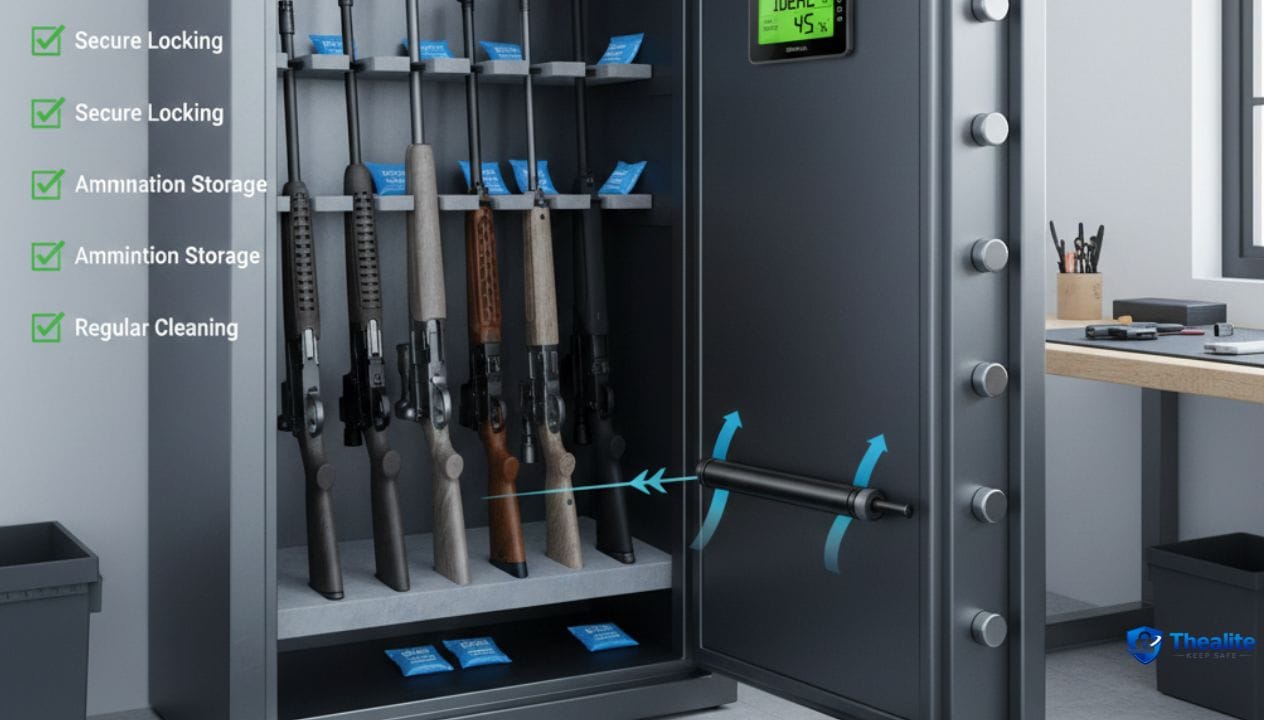
A gun safe is meant to protect firearms—but if humidity builds up inside, it can do the opposite. Moisture trapped in a safe can cause rust, pitting, musty odors, and damage to optics or accessories. This problem is especially common when safes are placed in garages, basements, or on concrete floors where temperature swings create condensation.
The solution is a simple humidity-control system: fix placement, keep the safe off concrete, add the right moisture-control tools (dehumidifier rod + desiccant), and monitor the results with a hygrometer. This guide is written for U.S. gun owners and focuses on safe, responsible storage.
Quick Answer
To keep a gun safe dry: place it in a climate-stable area (avoid garages/basements if possible), keep it off bare concrete, install an electric dehumidifier rod (if supported), add rechargeable desiccant, and put a hygrometer inside the safe to monitor humidity. Wipe down firearms and avoid putting damp items in the safe. Check humidity monthly and refresh desiccant on schedule.
Why Gun Safes Get Damp (Condensation Explained)
Gun safes are metal, and metal changes temperature quickly. When you open the door, humid air enters. Later, when the safe cools, moisture can condense on the interior surfaces. Without airflow, that moisture stays—and firearms are sensitive to it.
Common reasons gun safes stay humid
- Safe placed in a garage or basement (humidity + temperature swings).
- Safe sitting directly on concrete (cold base encourages condensation).
- Safe against an exterior wall (cool surface).
- Not enough desiccant capacity for the safe size.
- No dehumidifier rod in humid climates.
- Damp items stored inside (sweaty holsters, wet cases, recently cleaned guns).
Step 1: Put the Safe in a Better Location (If You Can)
Interior, climate-controlled rooms make humidity control easier. If you can place the safe inside the house (closet, office, interior wall), do it.
Better locations
- Interior closet in a conditioned room
- Office/bedroom closet away from exterior walls
- Climate-controlled room with stable temperature
High-risk locations
- Garages (hot days/cool nights)
- Basements (humidity common)
- Directly on concrete floors
- Against exterior walls
If you must use a garage, follow the garage-specific guide: Can You Keep a Gun Safe in the Garage.
Step 2: Keep the Safe Off Bare Concrete
Even indoors, concrete can hold moisture and stay cooler than air. Elevation reduces condensation risk at the base.
- Use a heavy-duty rubber mat or solid platform rated for the safe’s weight.
- Avoid carpet in damp areas (it can trap moisture).
- If the safe is in a basement, use extra humidity control layers.
Step 3: Use the Right Moisture-Control Tools
Most gun safes benefit from using two tools together: a dehumidifier rod (prevents condensation) plus desiccant (absorbs moisture).
Tool A: Dehumidifier rod (electric)
A dehumidifier rod gently warms the air inside the safe, which reduces condensation. It’s a common, effective solution for gun safes.
- Install according to the safe manufacturer’s guidance.
- Use a safe power pass-through if available; manage cords safely.
- Check periodically that it stays warm and remains plugged in.
Tool B: Desiccant (rechargeable silica gel)
Desiccant absorbs moisture. It’s especially helpful as a backup if power fails or if humidity spikes.
- Use enough for your safe size (bigger safe = more desiccant).
- Recharge/replace regularly (more often in humid seasons).
- Place in an area with airflow (not buried under gear).
Tool C: Hygrometer (measure humidity)
A hygrometer shows whether your system is working. Without it, you can’t tell if you need more moisture control.
- Place the hygrometer where it’s easy to read.
- Check monthly (weekly during humid seasons).
- If humidity stays high, add more desiccant or improve location/airflow.
Step 4: Prevent Rust on Firearms (Moisture Control Plus Habits)
Even with a dry safe, firearms can rust if they’re put away wet or handled without wiping them down.
Rust-prevention habits
- Wipe down metal surfaces after handling (fingerprints can accelerate corrosion).
- Avoid storing guns in damp fabric cases or foam that holds moisture.
- Keep holsters (especially leather) outside the safe if they retain moisture.
- Use appropriate corrosion protection per manufacturer guidance.
More rust prevention: Keep Guns From Rusting in Safe.
Step 5: What to Do If Your Gun Safe Already Smells Musty
A musty smell means moisture has already been trapped. Do a quick reset to protect your firearms.
Reset steps
- Remove firearms and valuables and let them air out in a dry room.
- Leave the safe door open for several hours (or overnight) to dry.
- Recharge/replace desiccant immediately.
- Install or verify dehumidifier rod operation.
- Add a hygrometer and monitor humidity for the next few days.
Maintenance Schedule (Simple and Realistic)
- Monthly: check hygrometer + smell test + quick visual check for rust.
- Every 1–3 months: recharge/replace desiccant (climate-dependent).
- Season changes: adjust moisture control (humidity spikes in summer in many regions).
- After range day: wipe down and let gear dry before storing.
Copy/Paste Checklist: Keep a Gun Safe Dry
- Safe placed in climate-stable area (avoid garage/basement if possible)
- Safe elevated off concrete (mat/platform)
- Dehumidifier rod installed and working
- Rechargeable desiccant added as backup moisture absorption
- Hygrometer inside safe to monitor humidity
- No damp cases/holsters stored inside; firearms wiped down before storage
- Monthly humidity + rust check; desiccant refreshed on schedule
FAQs
Do I need a dehumidifier rod in my gun safe?
In many homes, especially humid climates or garages/basements, a rod is one of the most effective tools to reduce condensation. Many owners also use desiccant for extra protection.
Is silica gel enough to keep a gun safe dry?
It can work in stable indoor locations if you use enough and recharge regularly. In humid or high-swing areas, combining desiccant with a rod usually works better.
Why do my guns rust even inside a safe?
Humidity, condensation, and storing damp gear can cause rust. Wipe down guns after handling, keep moisture-control tools working, and avoid damp cases/holsters.
Can I keep a gun safe in the garage without rust issues?
It’s possible, but you must manage humidity aggressively: keep the safe off concrete, use a rod + desiccant, and monitor with a hygrometer.
How do I remove a musty smell from my gun safe?
Dry the safe completely (door open), replace/recharge desiccant, verify rod operation, and monitor humidity with a hygrometer. Persistent musty odor means humidity is still too high.
Conclusion
Keeping a gun safe dry is about preventing condensation and controlling humidity. Start with the best location you can, keep the safe off concrete, use a dehumidifier rod plus desiccant, and measure humidity with a hygrometer so you know it’s working. Add simple habits like wiping down firearms and keeping damp gear out, and you’ll dramatically reduce rust and moisture damage over time.

As a digital marketer, she has received multiple international awards, including Campaign of the Year at the 2023 European Content Awards and Best Use of Content Marketing at the 2022 Global Search Awards. Nicai holds an MSc in Marketing (First Class Honours) from the UCD Smurfit Graduate Business School and she has also completed the Artificial Intelligence Programme at Oxford University’s Saïd Business School. She is also a contributing writer for publications such as Entrepreneur and Esquire.