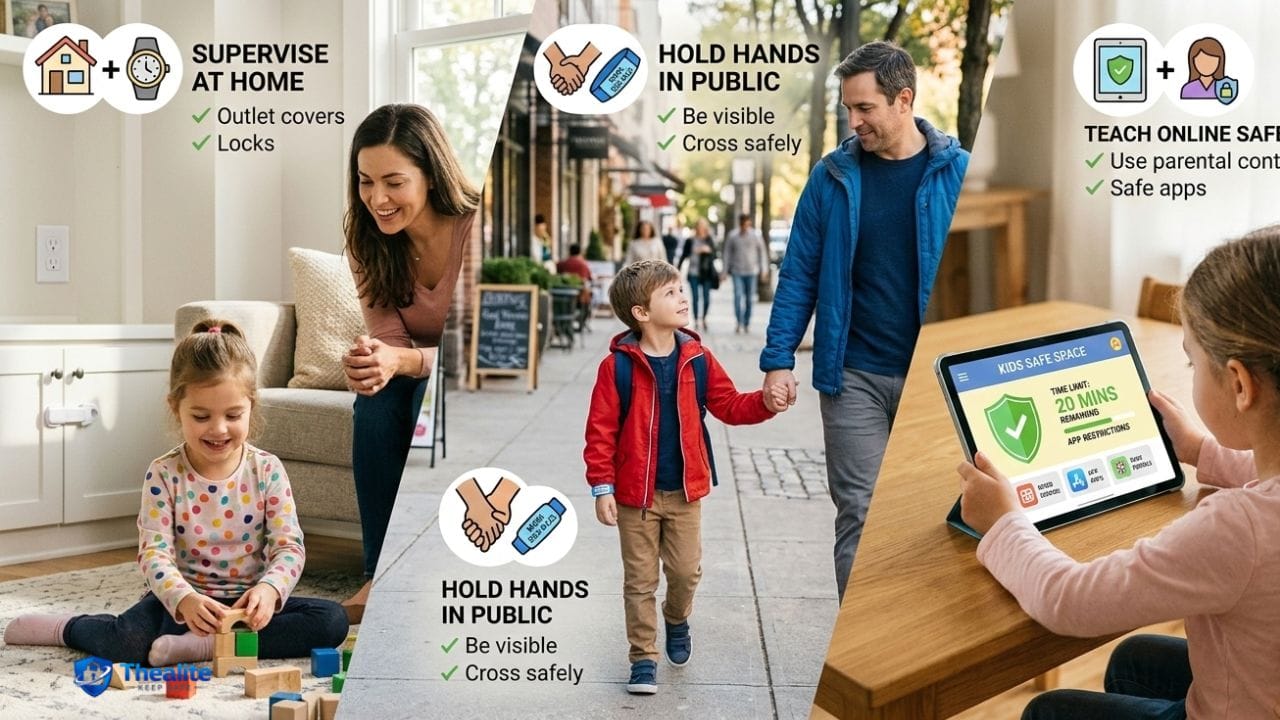
Every parent wants to keep their kids safe—but safety isn’t one giant rule. It’s a set of small, repeatable habits that reduce the most common risks: injuries at home, car accidents, separation in public, online scams, and emergency situations. The good news is that a basic safety system can cover most real-life scenarios without making kids fearful.
This U.S.-focused guide gives you a practical, layered approach. Use it like a menu: start with the highest-impact steps, then add more layers as your child grows.
Quick Answer (The Kids Safety System)
- Home safety: childproof hazards (meds, chemicals, choking items), secure furniture, safe sleep for infants.
- Car safety: correct car seat/booster + seat belts every ride; never leave kids in a car.
- Public safety: hand-holding rules, meeting spot plan, and ‘stop and stay’ if separated.
- Online safety: strong privacy settings, family rules, and teach kids to avoid scams and strangers.
- School safety: pickup routines, communication, and teaching kids what to do if they feel unsafe.
- Emergency planning: practice simple scripts and keep key contacts accessible.
- Teach age-appropriate rules repeatedly—kids follow what they can remember.
Step 1: Build a ‘Family Safety Routine’ (So You Don’t Rely on Luck)
Kids do best with repeatable routines. A safety routine is just a set of simple rules everyone follows.
Three rules that cover most situations
- Ask first: kids ask permission before leaving a room, yard, or public area.
- Stay visible: kids stay where an adult can see them (especially in public).
- Tell fast: kids tell an adult immediately if something feels wrong or confusing.
Step 2: Home Safety (Where Most Injuries Happen)
The home is where kids spend the most time, and it’s where most accidental injuries happen. Focus on the biggest hazards first.
High-impact home safety checklist
- Lock up medications, vitamins, and cannabis products (out of reach and preferably locked).
- Secure cleaning supplies and chemicals (under-sink cabinets need child locks).
- Prevent choking: keep small objects off floors/tables (coins, batteries, magnets).
- Anchor heavy furniture and TVs (tip-over risk).
- Use outlet covers and manage cords where needed.
- Water safety: never leave kids alone in a bath; keep toilet lids closed for toddlers.
If firearms are in the home
If there are guns in the home, the safest standard is locked storage, inaccessible to children, with strict adult access control.
Related safe storage: How to Keep Guns Safe at Home.
Step 3: Safe Sleep and Infant Safety
For babies, safety is mostly about safe sleep and preventing falls.
- Back to sleep on a firm, flat surface (crib/bassinet).
- No loose blankets, pillows, or stuffed animals in the sleep space.
- Never leave babies unattended on beds or couches (fall risk).
- Use correct car seats and install them properly.
Step 4: Car and Transportation Safety
Car crashes are one of the highest-risk situations for kids. Use the right restraints every time.
- Use the correct car seat/booster for your child’s age/size (follow manufacturer instructions).
- Buckle up every ride—even short trips.
- Keep kids in the back seat when possible (especially younger children).
- Never leave children alone in a car—not even for a minute.
Step 5: Public Place Safety (Stores, Parks, Events)
Most public safety issues come from separation and distractions. Use simple rules kids can remember.
The lost-child plan (easy script)
- If you can’t see your adult: STOP and stay where you are.
- Look for a safe helper (employee with name tag, security, or parent with kids).
- Say: “I’m lost. Can you help me call my parent?”
Public rules that help
- Hand-holding in parking lots (non-negotiable).
- Pick a meeting spot when entering a big place.
- Dress kids in bright/consistent colors in crowds.
- Take a quick photo before events (helps if separated).
More: How to Keep Your Child Safe in Public.
Step 6: School Safety and Pickup Rules
School safety is mostly about predictable routines: where to go, who can pick up, and what to do if something feels off.
- Have clear pickup rules and a family code word for changes.
- Teach kids to go to a trusted adult at school if they feel unsafe.
- Make sure the school has updated contact information.
More: How to Keep Your Child Safe at School.
Step 7: Online Safety (For Phones, Games, and Social Media)
Online safety is real-life safety now. Kids need rules and support—not just monitoring.
High-impact online rules
- No sharing personal info (full name, school, address, phone).
- No meeting online-only friends in real life.
- Use privacy settings and family controls where appropriate.
- Teach kids to report and block creepy messages or bullying.
- Keep devices updated and use strong passwords.
Related: How to Keep Kids Safe Online • How to Keep Your Child Safe on Social Media • How to Keep Kids Safe on Roblox
Step 8: Teach Kids About ‘Tricky People’ (Behavior-Based Safety)
Instead of only teaching ‘stranger danger,’ teach kids to watch for unsafe behavior—even from people they know.
- Anyone asking them to keep secrets from parents.
- Anyone trying to get them alone or away from public spaces.
- Anyone offering gifts or asking for photos/personal info.
- Anyone claiming ‘your parent sent me’ without the family code word.
Step 9: Emergency Planning (So Kids Don’t Freeze)
A little practice builds confidence. Kids handle emergencies better when they’ve rehearsed what to do.
- Teach kids their parent/guardian phone number (or keep it on an ID bracelet/card).
- Practice calling 911 in a calm way (what to say and the address).
- Create a simple meeting plan for home emergencies (fire, severe weather).
Step 10: Age-Based Safety Tips (What to Focus on by Stage)
Kids grow fast—your safety focus should evolve too.
Infants (0–12 months)
- Safe sleep and fall prevention are top priorities.
- Car seat use and supervision during feeding and bathing.
Toddlers (1–3 years)
- Choking hazards, water safety, and childproofing.
- Hand-holding rules in public and parking lots.
Preschool/Elementary (4–10)
- Lost-child plan, safe helpers, and tricky-people behaviors.
- Basic online rules for games and tablets.
Tweens/Teens (11+)
- Online safety, social media boundaries, and location privacy.
- Peer pressure, rides, and communication plans.
Copy/Paste Checklist: How to Keep Your Kids Safe
- Home: lock meds/chemicals; remove choking hazards; anchor furniture; water supervision
- Infants: safe sleep (back, firm surface, no loose bedding)
- Car: correct car seat/booster + seat belt every ride; never leave kids in car
- Public: parking lot hand-holding; meeting spot; ‘stop and stay’ if separated
- School: pickup rules + code word; updated contacts; trusted adult plan
- Online: no personal info; privacy settings; block/report; strong passwords
- Teach tricky-people behaviors (secrets, gifts, isolation, no code word)
- Emergency: teach phone/address; practice 911 script; family meeting plan
FAQs
What is the most important way to keep kids safe?
Consistent routines and active supervision—especially around water, streets, and kitchens—prevent many common injuries.
How can I keep my child safe in public places?
Use a meeting spot plan, teach the stop-and-stay rule if separated, and enforce hand-holding rules in parking lots.
How do I keep kids safe online?
Use privacy settings, teach kids not to share personal info, and encourage them to tell you immediately about creepy messages or bullying.
What is a family code word?
A code word is a secret family password used to verify unexpected pickup changes or requests. No code word means the child doesn’t go.
What should kids do if they find a gun?
Stop, don’t touch, leave the area, and tell an adult. Parents should also use locked storage to prevent access.
Conclusion
Keeping your kids safe is less about one perfect rule and more about layers: safer homes, consistent car restraints, clear public routines, strong online boundaries, and a simple emergency plan. Teach kids what to do in a way they can remember, and practice the routines until they become automatic.

As a digital marketer, she has received multiple international awards, including Campaign of the Year at the 2023 European Content Awards and Best Use of Content Marketing at the 2022 Global Search Awards. Nicai holds an MSc in Marketing (First Class Honours) from the UCD Smurfit Graduate Business School and she has also completed the Artificial Intelligence Programme at Oxford University’s Saïd Business School. She is also a contributing writer for publications such as Entrepreneur and Esquire.