Public places—stores, parks, festivals, airports, and busy sidewalks—are where parents feel the most anxiety, and for good reason: kids move fast, crowds are distracting, and it’s easy to lose sight of each other for a few seconds. The good news is that most public-safety risks are preventable with simple routines and a plan your child can remember.
This U.S.-focused guide shows you how to keep your child safe in public without creating fear. It includes a practical lost-child plan, how to teach kids to find safe help, and the habits that reduce risk in real-world situations.
Quick Answer (The Public Safety System)
- Use a pre-visit plan: where you’re going, what to do if separated, who to ask for help.
- Set a ‘stop and stay’ rule: if lost, stop where you are (don’t keep wandering).
- Teach safe helpers: store employee, uniformed staff, security, or a parent with kids.
- Use a family code word for any unexpected pickup or ‘emergency’ request.
- Keep small kids within arm’s reach in crowds and parking lots.
- Use bright/consistent clothing so you can spot your child quickly.
- Use a calm response if separation happens: alert staff, describe clothing, and search smart.
Step 1: Build a Simple “If We Get Separated” Plan
The best time to teach safety rules is before you need them. A simple plan reduces panic for both parent and child.
A 30-second pre-visit script
- “If you can’t see me, STOP and stay right where you are.”
- “If you need help, go to an employee or security (or a mom/dad with kids).”
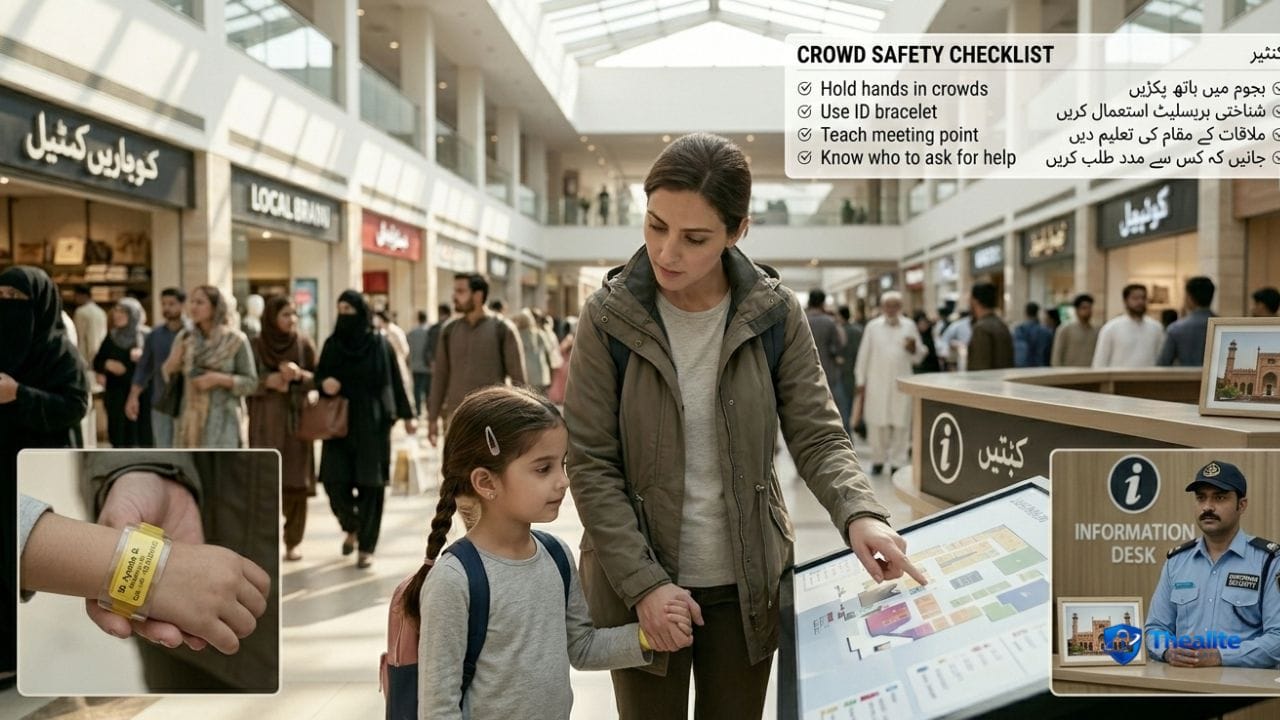
- “We will meet at the front door/customer service if we get separated.”
Choose a meeting spot
Pick one easy-to-find place: customer service desk, the entrance, or a clearly marked landmark. For parks, pick a specific bench or sign—not “near the playground.”
Step 2: Teach Kids the ‘Stop, Stay, and Get Help’ Rule
Most kids’ instinct is to wander and search. That makes separation worse. Teach the opposite: stop and get help.
Kids should do this
- Stop moving and stay in one safe spot.
- Look around for a safe helper (employee/security).
- Use a loud voice if needed: “I’m lost. I need help.”
Parents should do this
- Stay calm and search the last-seen location first.
- Notify staff immediately (store employees/security) so exits can be watched.
- Give a clear description: child’s name, age, height, and clothing colors.
Step 3: Safe Helpers vs ‘Stranger Danger’
Rather than only teaching ‘stranger danger,’ teach kids to recognize safe helpers—people whose job or situation makes them more likely to help.
Examples of safe helpers
- Store employee with a name tag
- Uniformed security guard or police officer
- Front desk staff (hotel, gym, venue)
- Lifeguard at a pool/beach
- A parent with children (as a backup choice)
Teach a simple request
“I’m lost. Can you help me call my mom/dad?” (Kids don’t need to give details—just ask for help contacting you.)
Step 4: The ‘Tricky People’ Concept
A safer way to teach boundaries is focusing on behaviors. ‘Tricky people’ can be strangers or familiar people who do unsafe things.
Red-flag behaviors to teach
- Asking the child to keep secrets from parents.
- Offering gifts or asking them to ‘come help’ somewhere isolated.
- Trying to get the child into a car or away from the public area.
- Asking for photos or personal information.
- Saying “Your parent told me to pick you up” without the code word.
Related deeper read: How to Keep Your Child Safe From Predators.
Step 5: Use a Family Code Word
A code word is one of the most effective safety tools because it’s easy for kids to remember and hard for outsiders to guess.
- Pick a word only your family knows (not your pet’s name or something public).
- Practice it occasionally: “If anyone says they’re picking you up, ask for the code word.”
- No code word = the child does not go with them, and they get a safe helper.
Step 6: Crowd and Event Safety
Crowds create two issues: separation and physical safety (strollers, pushing, traffic).
Crowd safety routines
- Keep young kids within arm’s reach in dense crowds.
- Hold hands in parking lots and near traffic (non-negotiable rule).
- Use bright clothing or a consistent color so you can spot your child fast.
- Take a quick photo of your child before entering a big event (for clothing reference if lost).
- Teach kids to stay at a landmark if you get separated (not keep moving).
Step 7: Shopping and Mall Safety
Stores are designed to distract kids and parents. Use simple store routines.
- Set rules at the door: “Stay where I can see you.”
- Use the cart for toddlers in busy stores.
- Teach kids not to go to parking lots alone—ever.
- If separated: go to customer service/front desk immediately.
Step 8: Park and Playground Safety
Parks are open spaces with fewer boundaries. Safety is about visibility, boundaries, and check-in habits.
- Pick a clear boundary: “You can play between these two points.”
- Choose a base spot where your child always returns (bench/blanket).
- Teach kids to check in at a set interval (every 10 minutes, after each activity).
- Be extra strict near water (ponds, splash pads).
Step 9: Parking Lot Safety
Parking lots are dangerous because of moving vehicles and distractions. Make rules strict.
- Hold hands or keep kids in the cart until safely inside the car.
- No running ahead, no walking behind cars, no wandering.
- Load kids first, then bags (reduces momentary separation).
Step 10: Tools That Help (Without Replacing Supervision)
Some tools can help in specific situations, but they don’t replace supervision.
- ID bracelet/card for younger kids (name + parent phone number).
- Location-sharing apps or wearable trackers for older kids (use with privacy awareness).
- Stroller straps or hand-holding tools for toddlers in crowds (as needed).
What to Do If Your Child Is Missing (Fast Action Plan)
If separation happens, speed matters. Use a calm, structured approach:
- Go to the last-seen spot immediately and scan nearby.
- Alert staff/security and ask them to watch exits.
- Give clothing description and show the photo you took (if you have it).
- Stay at the meeting spot so your child can find you if they follow the plan.
- If you believe your child is in immediate danger, call 911 in the U.S.
Copy/Paste Checklist: Keep Your Child Safe in Public
- Pre-visit plan: meeting spot + ‘stop and stay’ rule
- Teach safe helpers (employee/security/parent with kids)
- Family code word for any pickup change or ‘emergency’ request
- Crowds: keep young kids within arm’s reach; use bright clothing
- Parking lots: hold hands; kids loaded first, then bags
- Take a quick photo of child before big events (clothing reference)
- If separated: alert staff fast; describe clothing; stay at meeting spot
FAQs
What is the best rule to teach kids if they get lost in public?
Teach them to stop, stay where they are, and ask a safe helper (employee or security) for help calling you. Wandering makes it harder to reunite.
Who should my child ask for help if they are lost?
A store employee with a name tag, uniformed security or police, or a front desk staff member. If none are available, a parent with children is a reasonable backup choice.
What is a family code word and why does it help?
A code word is a secret word your family uses to verify a pickup change. If someone claims you sent them, your child asks for the code word—no code word means they do not go.
How can I prevent my child from running off in a store?
Set rules at the door, use the cart for toddlers, and keep your child within your sight line. Practice the meeting spot plan in advance.
What should I do if my child goes missing at a crowded event?
Alert security immediately, give a clear description and clothing colors, stay at the meeting spot, and call 911 if you suspect immediate danger.
Conclusion
To keep your child safe in public, use simple routines: a meeting spot plan, the stop-and-stay rule, safe helpers, and a family code word. Add crowd and parking lot habits, and practice short scripts so kids know what to do under stress. These steps reduce risk dramatically without making kids fearful.

As a digital marketer, she has received multiple international awards, including Campaign of the Year at the 2023 European Content Awards and Best Use of Content Marketing at the 2022 Global Search Awards. Nicai holds an MSc in Marketing (First Class Honours) from the UCD Smurfit Graduate Business School and she has also completed the Artificial Intelligence Programme at Oxford University’s Saïd Business School. She is also a contributing writer for publications such as Entrepreneur and Esquire.