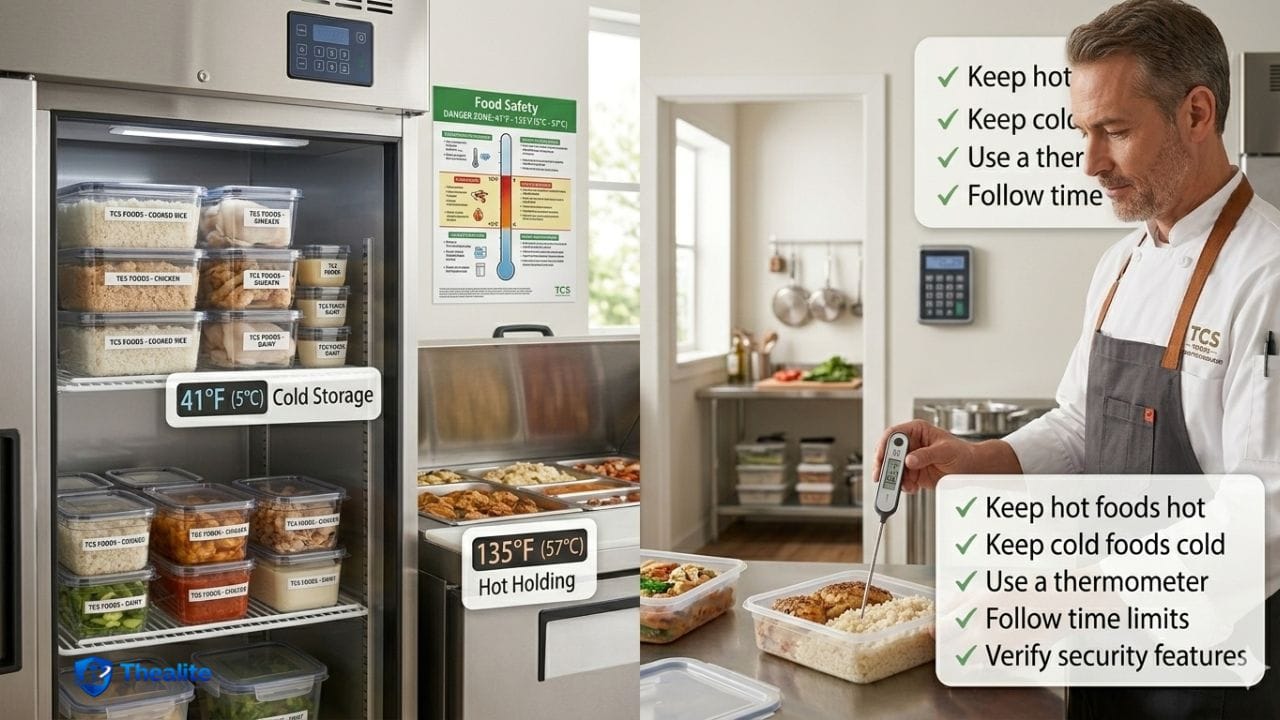
TCS foods (Time/Temperature Control for Safety foods) are the foods most likely to grow dangerous bacteria or form toxins if they’re held at unsafe temperatures for too long. That’s why professional kitchens and health departments focus so heavily on time + temperature control for these foods.
The best way to keep TCS foods safe is a simple system you can repeat every day keep cold foods cold, keep hot foods hot, pass quickly through the danger zone, and verify with a thermometer.
Quick Answer (The TCS Safety System)
- Keep cold TCS foods at 41°F (5°C) or below.
- Keep hot TCS foods at 135°F (57°C) or above.
- Minimize time in the danger zone (41°F–135°F).
- Cool cooked TCS foods fast 135→70°F within 2 hours then 70→41°F within 4 more hours (6 hours total).
- Reheat TCS foods for hot holding to 165°F (then hold at 135°F+).
- Cook foods to safe internal temps and verify with a thermometer.
- Use date marking, clean tools, and cross-contamination controls.
- Log temperatures and train staff (consistency prevents mistakes).
Step 1: Know What Counts as a TCS Food
TCS foods usually have the moisture and nutrients bacteria love. Common examples include:
- Meat, poultry, seafood (raw or cooked)
- Dairy products (milk, cream, soft cheeses)
- Shell eggs (raw or cooked)
- Cooked rice, beans, pasta, potatoes, and cooked vegetables
- Cut melons, cut tomatoes, and cut leafy greens
- Tofu and soy-protein foods
- Sprouts
- Garlic-in-oil mixtures (not treated for safety)
- Soups, stews, sauces, and gravies
If you’re unsure whether something is TCS, treat it like it is—then control time and temperature strictly.
Step 2: Control the Temperature Danger Zone
The temperature danger zone for TCS foods is commonly taught as 41°F to 135°F. The longer food stays in this range, the more opportunity bacteria have to multiply.
The two rules that prevent most problems:
- Cold holding rule: keep TCS foods 41°F or below.
- Hot holding rule: keep TCS foods 135°F or above.
Internal link idea: Keep Temperature Control for Safety Food Safe
Step 3: Receiving and Storage (Start Safe)
Food safety starts before cooking. If TCS food arrives warm or shows signs of temperature abuse, it can already be unsafe.
Receiving best practices
- Use a calibrated thermometer to spot-check delivery temps.
- Reject items that are out of temperature range, leaking, swollen, or past date.
- Put deliveries away immediately—don’t let boxes sit on the dock or counter.
Refrigerator and freezer storage habits
- Keep the fridge cold enough for food safety (and verify with a thermometer).
- Store raw meat below ready-to-eat foods to prevent drips and cross-contamination.
- Use sealed containers and labels (name + date).
- Don’t overload the fridge; air needs to circulate to keep temps stable.
Related: How Cold Should a Refrigerator Be to Keep Food Safe • Practices That Keep Cold Food Safe
Step 4: Cooking TCS Foods Safely (Use a Thermometer)
Cooking kills pathogens when food reaches the correct internal temperature. The safest approach is simple: use a food thermometer rather than guessing by color or texture.
Common safe minimum internal temperatures (U.S. guidance)
- Poultry (chicken, turkey) 165°F
- Ground meats (beef, pork, lamb): 160°F
- Whole cuts of beef/pork/veal/lamb: 145°F + rest time (follow your local code/training)
- Reheated leftovers (for hot holding): 165°F
Always follow your local health code and your training program requirements, and document cooking temps in a log if you’re in a food service setting.
Step 5: Hot Holding (Buffets, Steam Tables, Catering)
Hot holding is where many TCS foods become unsafe. A steam table keeps food hot—it does not cook food. Food must be cooked/reheated safely first, then held hot.
- Hold hot TCS foods at 135°F or above.
- Stir and check the cold spots (edges and corners) where temps drop.
- Keep lids on pans when possible to hold heat and reduce contamination.
- Replace small pans more often rather than topping off (cleaner and safer).
Soup examples: How to Keep Soup Safe on a Buffet Line • Food Workers Required to Keep Soup Safe
Step 6: Cold Holding (Salads, Prep Lines, Grab-and-Go)
Cold holding fails when food sits out during prep or service. Your goal is to keep TCS foods cold and limit time out of refrigeration.
- Hold cold TCS foods at 41°F or below.
- Use shallow pans and keep foods nestled in ice when applicable.
- Return items to the fridge between prep steps instead of leaving everything out.
- Don’t mix fresh product with old product (use FIFO).
Step 7: Cooling Cooked TCS Foods the Right Way
Cooling is one of the most tested food-safety topics because it’s easy to do wrong. Big pots cool slowly, and slow cooling keeps food in the danger zone for too long.
The standard cooling rule (easy to remember):
- Cool from 135°F to 70°F within 2 hours.
- Then cool from 70°F to 41°F within 4 more hours (6 hours total).
Cooling methods that actually work
- Divide food into shallow pans (more surface area).
- Use an ice bath and stir (great for soups and sauces).
- Use ice paddles/cooling wands for thick items.
- Loosely cover or vent while cooling (then cover tightly once cold).
- Use blast chillers if you have them (best for speed + consistency).
Tip: label cooled food with the date/time so you know when it must be used or discarded.
Step 8: Reheating TCS Foods
Reheating must be fast enough to get food out of the danger zone. For foods that will be held hot, the common rule is to reheat to 165°F, then hold at 135°F+.
- Reheat quickly (don’t use hot-holding equipment like steam tables to reheat).
- Stir during reheating so heat is even.
- Check temperature in the thickest part of the food.
Step 9: Time as a Control (When You Can’t Hold at Temperature)
Sometimes food service operations use time as a public health control (TPHC) instead of temperature. This is a regulated method: food is marked with a time and discarded after a defined window. If your operation uses this method, follow your local health department rules exactly.
Step 10: Tools, Monitoring, and Training (How You Make It Consistent)
The ‘best way’ to keep TCS foods safe is the way you can repeat every shift.
Must-have tools
- A calibrated probe thermometer (and alcohol wipes)
- Temperature logs for cold holding, hot holding, cooling, and reheating
- Labels and markers for date marking
- Shallow pans, ice bath setup, and cooling tools (paddles)
Thermometer habits
- Calibrate on a schedule (ice-point method is common).
- Check temps in the coldest/hottest spots (not just the surface).
- Record temps and corrective actions (what you did to fix a problem).
Step 11: Hygiene and Cross-Contamination Still Matter
Time and temperature control is huge, but it’s not the only risk. Cross-contamination and poor hygiene can contaminate food even at safe temperatures.
- Wash hands correctly and often; change gloves when tasks change.
- Keep raw and ready-to-eat foods separate.
- Sanitize cutting boards, knives, and prep surfaces.
- Use clean utensils and replace them regularly on the line.
Related: Wearing Gloves Can Keep Food Safe By • How to Keep Food Safe
Copy/Paste Checklist: Best Way to Keep TCS Foods Safe
- Identify TCS foods and treat uncertain items as TCS
- Keep cold TCS foods at 41°F or below (verify with thermometer)
- Keep hot TCS foods at 135°F or above (verify and stir to check cold spots)
- Cook to safe internal temperatures (use a probe thermometer)
- Cool correctly: 135→70°F in 2 hours; 70→41°F in 4 hours
- Reheat for hot holding to 165°F, then hold at 135°F+
- Limit time out of temperature control during prep and service
- Use date marking (labels) and FIFO rotation
- Prevent cross-contamination (separate raw/RTE; sanitize tools)
- Log temps and corrective actions; calibrate thermometers regularly
FAQs
What does TCS stand for in food safety?
TCS stands for Time/Temperature Control for Safety. These foods require time and temperature controls to limit pathogen growth or toxin formation.
What is the temperature danger zone for TCS foods?
A commonly used range in U.S. food safety guidance is 41°F to 135°F. The goal is to keep TCS foods out of this range as much as possible.
What are the basic holding temperatures for TCS foods?
Cold holding is typically 41°F or below, and hot holding is typically 135°F or above, verified with a thermometer.
What’s the correct way to cool cooked TCS food?
Cool from 135°F to 70°F within 2 hours, then to 41°F within 4 more hours (6 hours total). Use shallow pans, ice baths, and stirring to speed cooling.
Why is a thermometer so important?
Because you can’t see, smell, or taste dangerous bacteria. A thermometer verifies cooking, holding, cooling, and reheating temperatures accurately.
Conclusion
The best way to keep TCS foods safe is consistent control of time and temperature: keep cold foods at 41°F or below, keep hot foods at 135°F or above, cool quickly, reheat properly, and verify everything with a thermometer and logs. When you combine these steps with clean hands, clean tools, and cross-contamination prevention, you dramatically reduce the risk of foodborne illness.

As a digital marketer, she has received multiple international awards, including Campaign of the Year at the 2023 European Content Awards and Best Use of Content Marketing at the 2022 Global Search Awards. Nicai holds an MSc in Marketing (First Class Honours) from the UCD Smurfit Graduate Business School and she has also completed the Artificial Intelligence Programme at Oxford University’s Saïd Business School. She is also a contributing writer for publications such as Entrepreneur and Esquire.