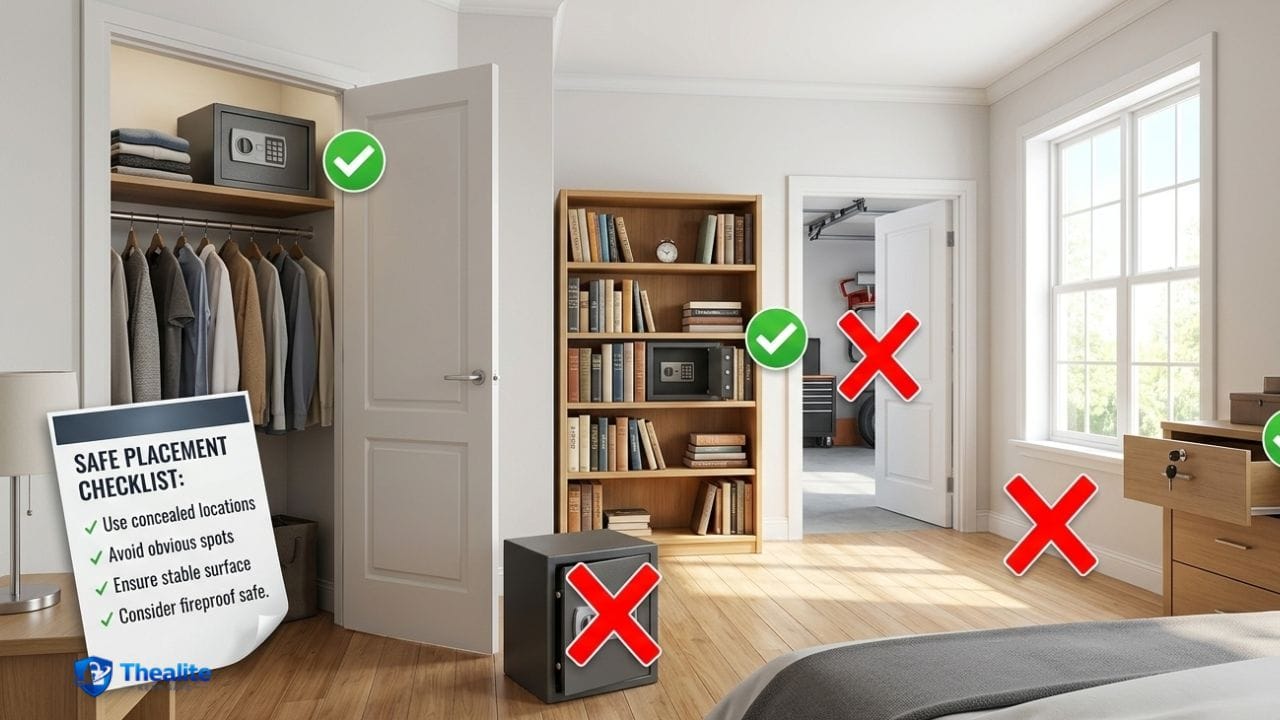
Where you place a safe matters almost as much as the safe you buy. A safe in the wrong location can be easier to find, easier to steal, and more likely to suffer moisture damage or fire exposure. A safe in the right location is harder to access, harder to remove, and more likely to protect your valuables.
This U.S.-focused guide explains the best places to keep a safe in your home, what to avoid, and how to think about placement using three priorities (1) burglary resistance, (2) fire/water risk, and (3) practical access for you.
Quick Answer
The best place to keep a safe in your home is a discreet, low-traffic, climate-stable area where you can bolt it down (to concrete or studs) and where it’s not the first place burglars search. For many homes, that means an interior closet, a utility room, or a secured office area—not the master bedroom closet, not the garage, and not a damp basement corner.
The 3 Things That Decide the Best Safe Location
Use these three priorities when picking a spot:
1) Burglary resistance
- Harder to find quickly.
- Harder to access with tools.
- Harder to remove (bolted down).
2) Fire and water risk
- Away from common ignition zones (kitchen/heater closets).
- Not in a flood-prone area (basement floors).
- Not next to plumbing that can leak (water heater, laundry hookups).
3) Practical access
- You can get to it without advertising it.
- You’ll actually use it (safe habits beat ‘perfect’ but unused placement).
Step 1: Avoid the Most Common Placement Mistake (Master Bedroom Closet)
The master bedroom closet is one of the first places burglars search. It feels private, but it’s also predictable. If you want burglary resistance, avoid placing the safe in the most obvious “valuables” area.
Step 2: Don’t Put a Safe in the Garage (Usually)
Garages often have easier forced entry and bigger temperature swings. Humidity and heat can also increase moisture problems inside safes. If you must use a garage, it’s critical to bolt the safe down and control moisture—but an interior space is usually better.
Step 3: Be Careful With Basements (Moisture and Flood Risk)
Basements can be good for concealment and anchoring to concrete, but they have a big downside: moisture and flood risk. If your basement is humid, you need moisture control and elevation.
- Keep the safe off bare concrete when possible (use a barrier/riser).
- Use moisture control inside the safe (desiccant/dehumidifier).
- Avoid placing it near sump pumps, drains, or water heaters.
Moisture help: How to Keep Moisture Out of a Safe • How to Keep a Safe Dry.
Best Places to Put a Safe (Room-by-Room Options)
The best location depends on your home layout. Here are common options with pros/cons.
1) Interior closet (not the master closet)
- Pros: discreet, climate-stable, not obvious to visitors, easy to access.
- Cons: may limit safe size; anchoring depends on floor structure.
2) Home office (secured area)
- Pros: you can access it without going through bedrooms; good for documents.
- Cons: office can be a target if burglars see electronics; keep the safe discreet.
3) Utility room or pantry-adjacent storage (careful with plumbing)
- Pros: low-traffic; not where burglars search first.
- Cons: avoid water heaters, pipes, and laundry hookups to reduce leak risk.
4) Basement (only if dry and elevated)
- Pros: concrete floor makes bolting easier; can be discreet.
- Cons: humidity/flood risk; requires moisture control and safe elevation.
5) Inside a built-in cabinet (custom concealment)
- Pros: strong concealment; can look like normal cabinetry.
- Cons: must still be bolted; avoid creating a “secret obvious spot” near bedrooms.
Step 4: Bolt It Down (A Safe That Isn’t Anchored Can Be Stolen)
A heavy safe can still be removed with a dolly and time. Bolting a safe down is one of the best upgrades you can make.
- Anchor to concrete (basement slab) when possible, or to floor/wall studs with proper hardware.
- Follow the safe manufacturer’s anchoring instructions.
- If renting, check lease rules before drilling; consider heavier safes or alternative anchoring options.
Step 5: Keep It Discreet (Privacy Is a Security Layer)
Even the best safe location gets weaker if too many people know about it. Privacy reduces targeting and ‘inside information’ theft.
- Don’t show guests your safe or talk about what you store.
- Avoid posting valuables online in a way that signals you have a safe.
- Limit who knows the code and change it if you suspect it was shared.
Step 6: Plan for Fire and Water
Safe placement should reduce exposure to the most likely disaster scenarios in your home.
- Avoid placing the safe in kitchens, near ovens, or near fireplaces (higher ignition risk).
- Avoid placing the safe directly under bathrooms or plumbing lines if possible.
- If in basement: choose the highest, driest corner and elevate the safe base.
Step 7: Match the Location to What You Store
A safe for documents has different needs than a safe for cash, jewelry, or firearms.
Documents and IDs
Prioritize fire resistance and a climate-stable area. Keep digital backups separately.
Related: How to Keep Important Documents Safe at Home.
Cash and valuables
Prioritize theft resistance (discreet placement + bolt-down) and moisture protection.
Related: How to Keep Cash Safe at Home.
Firearms
Prioritize locked storage inaccessible to children and visitors, and avoid humid spaces. Moisture control matters.
Related: How to Keep Guns Safe at Home.
Copy/Paste Checklist: Where to Keep a Safe in Your Home
- Choose a discreet, low-traffic, climate-stable location
- Avoid master bedroom closet, garage, and damp basement corners
- Reduce fire/water risk (away from kitchens, heaters, and plumbing leaks)
- Bolt the safe down to concrete or studs with proper hardware
- Use moisture control if in basement/humid climate (desiccant/dehumidifier)
- Keep location/code private; limit who knows about the safe
- Match placement to what you store (documents vs cash/jewelry vs firearms)
FAQs
Where is the safest place to put a safe in your house?
A discreet, climate-stable interior area where the safe can be bolted down—such as an interior closet or secured office area—is often a strong choice.
Why is the master bedroom closet a bad place for a safe?
Because it’s one of the first places burglars search for valuables. Predictable locations reduce burglary resistance.
Is it okay to keep a safe in the garage?
Usually it’s not ideal because garages have easier forced entry and temperature/humidity swings. If you must, bolt it down and control moisture.
Can I keep a safe in the basement?
Yes if the basement is dry and you manage moisture. Keep the safe elevated, away from leaks, and use moisture control.
Do I really need to bolt my safe down?
Yes. A safe that isn’t anchored can be removed and opened elsewhere. Anchoring is one of the highest-impact security upgrades.
Conclusion
The best place to keep a safe in your home is one that balances security and practicality: hard to find, hard to remove, and protected from moisture and fire risk—while still being accessible enough that you actually use it. Avoid predictable spots like the master closet, bolt the safe down, and add moisture control where needed.

As a digital marketer, she has received multiple international awards, including Campaign of the Year at the 2023 European Content Awards and Best Use of Content Marketing at the 2022 Global Search Awards. Nicai holds an MSc in Marketing (First Class Honours) from the UCD Smurfit Graduate Business School and she has also completed the Artificial Intelligence Programme at Oxford University’s Saïd Business School. She is also a contributing writer for publications such as Entrepreneur and Esquire.