Propane is incredibly useful for grilling, patio heaters, and some RV/camping setups—but it’s also a flammable gas stored under pressure. That’s why a common question comes up every season: is it safe to keep a propane tank in the garage?
In most U.S. homes, the safest general answer is: store propane cylinders outdoors, not inside the home and not in an attached garage. Garages often have ignition sources (power tools, switches, chargers, vehicles—and sometimes appliances), and propane is heavier than air. If a cylinder leaks, the gas can sink and collect near the floor where sparks can ignite it.
This guide explains why garages are risky, what safer storage looks like, how to reduce risk if you’re temporarily holding a cylinder, and a simple checklist you can follow.
Quick Answer
For most households, it’s not recommended to store a standard propane cylinder (like a 20‑lb grill tank) in an attached garage because a leak can allow propane to pool near the floor, and garages often contain ignition sources. The safest approach is to store propane cylinders outside, upright, in a shaded, well‑ventilated spot, away from doors/windows and away from heat or flames. If local rules allow a detached, well‑ventilated shed or similar structure, follow those rules carefully—and always check your local fire code guidance.
Why Garages Are Risky for Propane Storage
Three properties make propane risky in enclosed spaces:
1) Propane is heavier than air
If propane leaks, it tends to sink and spread along floors. A garage floor can act like a collection area, especially in still air.
2) Garages often have ignition sources
- Power tools, battery chargers, and extension cords
- Light switches and electrical outlets
- Vehicles (hot engines, sparks, and fuel vapors)
- In some homes: water heaters, furnaces, or appliances located in/near the garage
3) Temperature swings can raise pressure
Propane cylinders are designed to handle pressure changes, but heat still matters. A tank stored in a hot garage can experience higher internal pressure. You never want a cylinder near heaters, direct sunlight through windows, or other heat sources.
What ‘Safe’ Actually Means
When people say “safe,” they usually mean one of these:
- Leak + ignition risk (fire/explosion).
- Cylinder damage risk (impact, valve damage, tipping).
- Legal/insurance risk (local rules about indoor storage).
The safest plan reduces all three.
The Safest Place to Store a Propane Tank at Home
For most people, the safest default is outdoors with natural ventilation.
Best outdoor storage setup
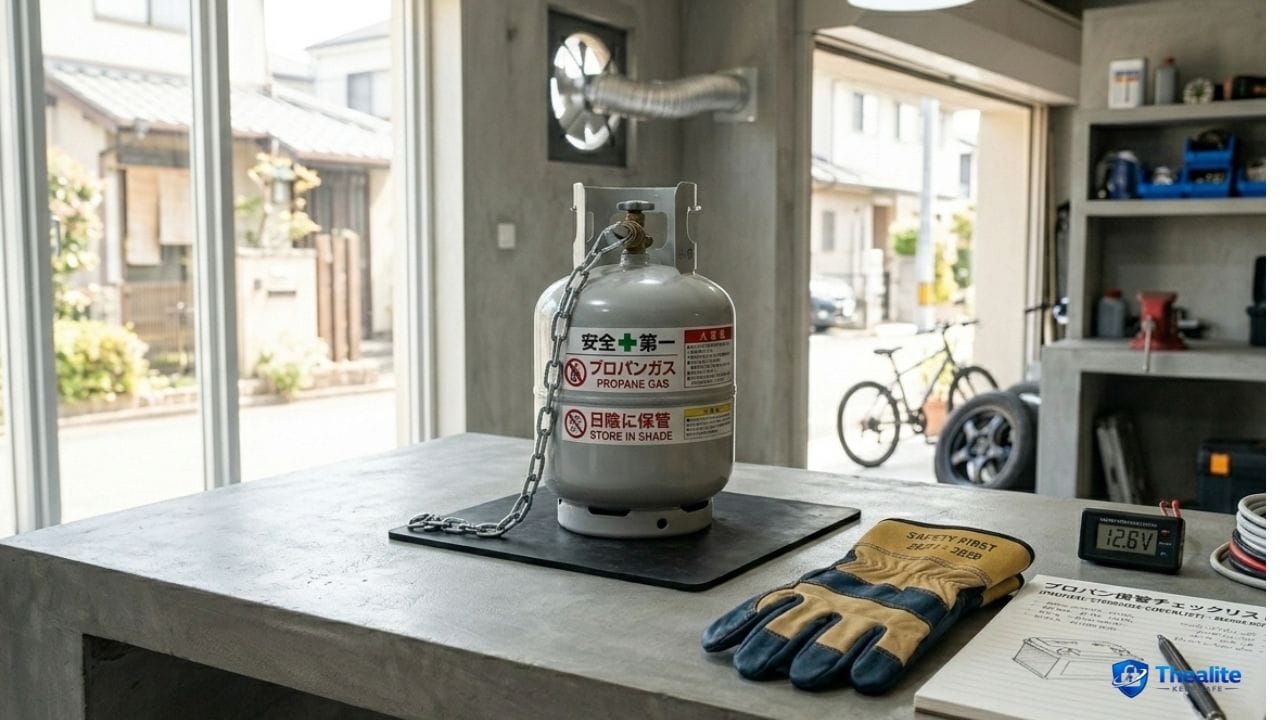
- Store cylinders upright on a stable, level surface (concrete pad, pavers, or packed gravel).
- Keep the valve closed and ensure the protective cap/cover is on if your cylinder uses one.
- Choose a shaded area (avoid direct sun and high heat).
- Keep away from open flames, grills in use, and other ignition sources.
- Keep away from doors, windows, and vents (so leaked gas doesn’t flow indoors).
- Prevent tipping: don’t store where kids, pets, or wind can knock it over.
Good outdoor storage spots
- Along an exterior wall in a shaded area (with space and airflow)
- Under an open, well-ventilated cover (like an open-sided carport area), if local rules allow
- A designated propane storage area away from foot traffic
Places to avoid outdoors
- Inside enclosed sheds without ventilation
- Near basement windows or crawlspace vents
- Near air conditioner intakes or dryer vents
- Next to flammable storage (gasoline cans, paint thinner, propane heaters)
What About a Detached Garage or Shed?
Some homeowners store propane cylinders in a detached garage or shed for shade and weather protection. Whether that’s acceptable depends on local rules and ventilation. The key question is: can gas escape freely if there’s a leak? If not, it’s not a good place for storage.
If you use a detached structure, follow these rules
- Ventilation is non-negotiable (airflow is the goal).
- Store cylinders upright, away from electrical tools and ignition sources.
- Keep it cool—avoid hot, sealed spaces.
- Don’t store near gasoline, solvents, or other flammables.
- Don’t store where vehicles or heavy items could bump the cylinder.
Common Myths (And What to Do Instead)
Myth: “It’s fine in the garage if it’s empty.”
Even “empty” cylinders can contain propane vapor. Treat them as potentially hazardous and store them safely the same way.
Myth: “Cracking a garage door makes it safe.”
Partial opening can help ventilation, but it doesn’t remove ignition sources or guarantee gas won’t pool. Outdoor storage is still safer.
Myth: “I’ll hide it in a corner.”
Corners often have worse airflow. A safer plan is a stable outdoor spot where the cylinder is upright and protected from impact.
Safe Handling Habits
These habits reduce risk no matter where the cylinder is:
- Keep cylinder upright at all times (especially in transport and storage).
- Close the valve fully when not in use.
- Inspect for damage: dents, rust, valve issues, or unusual odor.
- Don’t store next to heat sources or in direct sun for long periods.
- Don’t leave the tank in a hot car trunk or closed vehicle.
If You Smell Gas: What to Do
Propane is odorized so leaks are easier to notice. If you smell propane:
- Do not turn on lights or create sparks.
- Ventilate the area if it’s safe to do so (open doors/windows).
- Move people and pets away.
- If the smell is strong or persistent, contact your propane supplier or emergency services per local guidance.
Copy/Paste Checklist: Safe Propane Tank Storage
- Store propane cylinders outdoors in a shaded, ventilated spot
- Keep cylinder upright on a stable surface
- Valve fully closed when not in use
- Keep away from doors/windows/vents and away from heat/flames
- Avoid storing standard grill cylinders in an attached garage
- If using a detached shed/garage: ensure strong ventilation and keep away from ignition sources
- Inspect cylinder condition (rust, dents, valve) and replace if damaged
- If you smell gas: avoid sparks, ventilate, move away, and contact help
FAQs
Is it legal to store a propane tank in a garage?
Rules vary by location and by cylinder size. Many areas restrict indoor storage of standard grill cylinders, especially in attached garages. Check your local fire code or local fire department guidance.
Can I store a propane tank in a detached garage?
Sometimes people do, but ventilation and ignition sources matter. If the space is enclosed and can trap gas, outdoor storage is usually safer.
Can propane tanks explode in the cold?
Cold usually isn’t the main explosion risk—heat and leaks near ignition sources are bigger concerns. Outdoor winter storage is common if the tank is upright and protected from damage.
Should I store propane next to gasoline cans?
No. Keep propane cylinders away from gasoline, solvents, and other flammables to reduce fire risk.
Is it safer to keep propane in the basement?
No. Basements can trap heavier-than-air gas. Outdoor storage is the safer default.
Conclusion
So, is it safe to keep a propane tank in the garage? In most cases, it’s not the safest choice—especially in an attached garage where propane can pool near the floor and ignition sources are common. The safest default is simple: store propane cylinders outside, upright, shaded, and ventilated—away from openings and heat. If you’re considering a detached structure, make sure ventilation and local rules support it. A few careful habits dramatically reduce risk.
Related reading on your site: How to Keep Your Home Safe • Is It Safe to Keep a Car Battery in the House • Is It Safe to Keep a Lighter in Your Car • How to Keep Lithium Batteries Safe

As a digital marketer, she has received multiple international awards, including Campaign of the Year at the 2023 European Content Awards and Best Use of Content Marketing at the 2022 Global Search Awards. Nicai holds an MSc in Marketing (First Class Honours) from the UCD Smurfit Graduate Business School and she has also completed the Artificial Intelligence Programme at Oxford University’s Saïd Business School. She is also a contributing writer for publications such as Entrepreneur and Esquire.