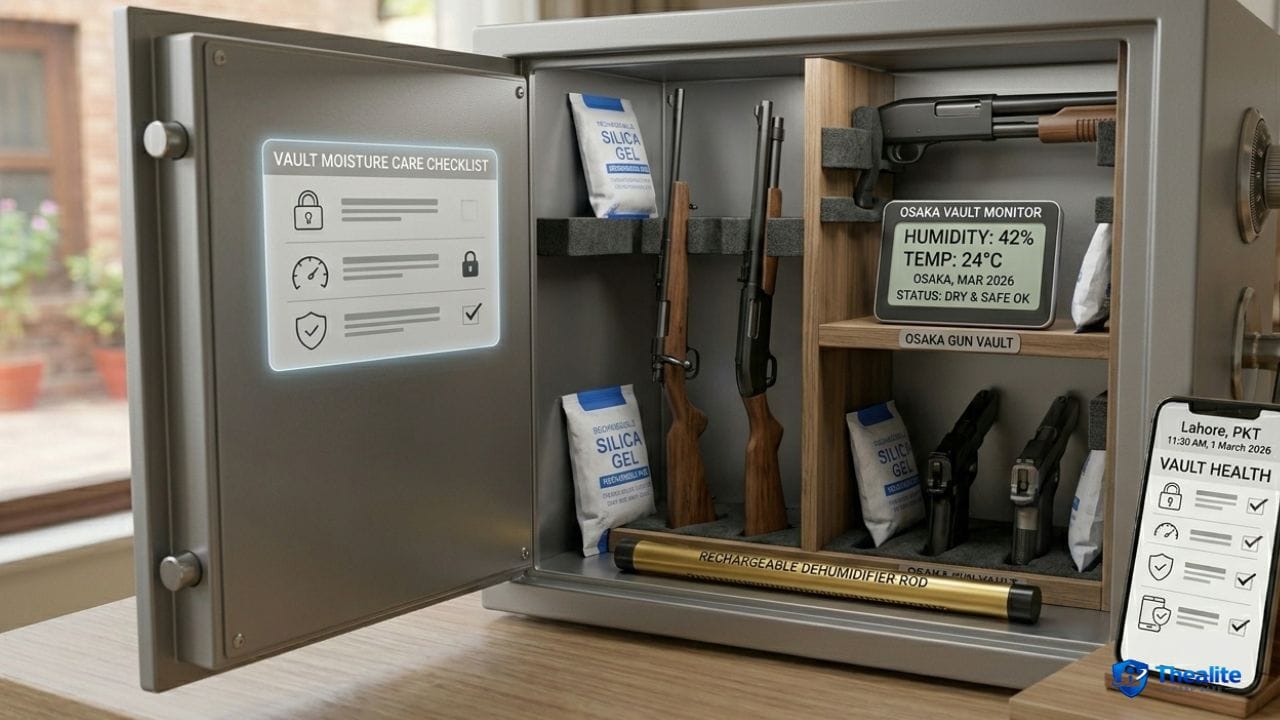
Moisture is the silent enemy of any safe, but it’s especially damaging inside a gun safe. Even small humidity swings can lead to surface rust, pitting, musty odors, damaged optics, and mold on leather slings or soft cases. The good news is you don’t need a complicated setup—you need a simple humidity-control system and a few storage habits.
This U.S.-focused guide explains why moisture builds up in safes, the best ways to dry a gun safe (desiccants vs electric dehumidifiers), how to choose the right humidity level, and a step-by-step checklist you can follow.
Quick Answer (The 7-Step Moisture Control System)
- Place the safe in a dry, climate-stable spot (avoid damp basements and exterior walls).
- Add a hygrometer (humidity gauge) so you’re not guessing.
- Aim for roughly 40–50% relative humidity to prevent rust while avoiding extreme dryness.
- Use an electric dehumidifier rod/safe heater for continuous control (great for larger safes).
- Use desiccant as a backup layer (recharge or replace regularly).
- Improve airflow inside the safe and keep wet items out.
- Maintain firearms for storage (wipe-down + light protective film; avoid foam case traps).
Why Moisture Builds Up in Gun Safes
Safes can trap humidity the way a closed closet does—except a safe is tighter, often placed in less-ideal locations (basements/garages), and made of thick metal that can get colder than the room air. Moisture usually comes from one or more sources:
- Humid air trapped inside when you open/close the door (especially in summer).
- Cold-to-warm temperature swings that create condensation on metal.
- Damp floors or basement air raising humidity around the safe.
- Wet items stored inside (damp holsters, cleaning rags, recently handled guns).
- Poor airflow when the safe is packed tightly with cases and gear.
Your goal is to keep humidity stable and low enough to prevent corrosion, without drying out wood stocks or other sensitive materials.
Target Humidity: What’s a Good Range?
A practical target for many gun safes is about 40–50% relative humidity. If your safe is consistently above that range, rust risk increases—especially with temperature swings. If it’s far below that range for long periods, some materials (wood, leather) can dry excessively. The key is stability and monitoring.
Step 1: Put the Safe in the Right Place
Where the safe sits matters as much as what you put inside. Moisture control is easier in a stable, conditioned space.
Best locations
- Interior room with HVAC (closet or office in a conditioned area).
- Away from exterior walls and away from known damp zones.
Locations to avoid (or manage carefully)
- Damp basements (humidity trap).
- Garages (big temperature swings).
- Direct contact with bare concrete (moisture transfer + colder surface).
- Exterior walls (higher chance of condensation in some climates).
If your safe must sit on concrete
- Use a barrier under the safe (rubber mat, safe risers, or sealed platform).
- Keep the room’s humidity controlled (room dehumidifier may be needed).
Step 2: Measure Humidity (Hygrometer = Cheap Insurance)
The fastest way to fix a moisture problem is to stop guessing. A small hygrometer tells you whether your setup is working. Place it inside the safe at mid-height and check it daily at first, then weekly once stable.
- If humidity stays high: add continuous control (rod/heater) and/or treat the room.
- If humidity swings wildly: focus on placement and airflow, not just desiccant.
- If humidity is too low: reduce heat/dehumidification and monitor stored wood/leather.
Step 3: Choose Your Moisture Control Method
There are two main approaches: continuous heat/dehumidification or absorbent desiccants. Many owners use both: rod for baseline + desiccant for spikes.
Option A: Electric dehumidifier rod / safe heater (continuous control)
A dehumidifier rod (often called a safe heater) warms the air slightly. Warmer air holds more moisture and helps prevent condensation on cold metal. This method is popular because it runs continuously with minimal maintenance.
- Best for: medium/large safes, humid climates, long-term storage.
- Pros: steady protection, low maintenance, reduces condensation risk.
- Cons: requires power access; needs safe cord routing.
Option B: Desiccants (silica gel / rechargeable canisters)
Desiccants absorb moisture from the air. They’re simple and don’t require power, but they saturate and must be recharged or replaced.
- Best for: smaller safes, mild climates, or as a backup layer.
- Pros: no electricity, inexpensive, portable.
- Cons: ongoing maintenance; can be overwhelmed in very humid areas.
Option C: Treat the room (dehumidify the space)
If your safe lives in a damp basement, controlling the room can be more effective than fighting humidity only inside the safe.
- Best for: basements, humid rooms, multiple storage needs.
- Pros: improves everything in the room.
- Cons: higher cost and maintenance than a small safe rod.
More safe moisture strategies: What to Put in a Safe to Keep Moisture Out • How to Keep a Safe Dry.
Step 4: Improve Airflow Inside the Safe
Humidity control works better when air can move. Packed safes create damp pockets.
- Leave small gaps between items (don’t jam cases tight together).
- Avoid covering airflow paths or blocking the dehumidifier rod area.
- Rotate and air out soft goods (slings, pouches) occasionally (when safe to do so).
Step 5: Store Firearms and Gear the Rust-Smart Way
Moisture control is powerful, but storage habits still matter. Rust often starts from fingerprints, trapped moisture, and tight foam contact.
Do these things
- Wipe down metal surfaces after handling (fingerprints can promote corrosion).
- Use a light protective film/oil suitable for storage (per manufacturer guidance).
- Make sure firearms are dry before storing after rain/hunting/cleaning.
- Keep optics and electronics dry; store batteries appropriately.
Avoid these common rust triggers
- Long-term storage in foam-lined cases (foam can trap moisture).
- Storing wet leather slings/holsters inside the safe (leather holds moisture).
- Leaving a damp rag or cleaning patch inside the safe.
Rust prevention deep dive: Keep Guns From Rusting in Safe.
Step 6: Door Seal and Access Habits
Every time you open the safe, you exchange air. That’s normal, but in humid weather it can cause spikes.
- Avoid leaving the door open for long periods during humid days.
- After long openings, re-check humidity later (your hygrometer tells the truth).
- Inspect the door seal/gasket if your safe has one; damaged seals can worsen humidity control.
Step 7: Troubleshooting (If You Still Get Rust or Musty Smell)
If your safe still feels damp, work through this sequence:
- Confirm the reading with a hygrometer (don’t guess).
- Upgrade to continuous control (rod/heater) if humidity stays high.
- Recharge/replace desiccants more often (they may be saturated).
- Treat the room with a dehumidifier if the space itself is damp.
- Remove moisture-holding items (foam cases, leather, cloth) or store them differently.
- Check placement: safe against a cold exterior wall or on bare concrete increases condensation risk.
Copy/Paste Checklist: Keep Moisture Out of a Gun Safe
- Safe placed in a dry, climate-stable spot (avoid damp basements/garages if possible)
- Barrier under safe if on concrete (mat/risers/platform)
- Hygrometer installed and checked routinely
- Target humidity about 40–50% (adjust for your climate and stored materials)
- Electric dehumidifier rod/heater used for continuous control (if needed)
- Desiccant added as backup; recharged/replaced on schedule
- Avoid foam case storage long-term; keep leather/wet items out
- Wipe down firearms after handling; use a light protective film/oil appropriately
FAQs
What humidity should a gun safe be?
A practical target for many setups is around 40–50% relative humidity. Use a hygrometer and adjust based on your climate and what you store (wood, leather, etc.).
Are dehumidifier rods better than silica gel?
Rods provide continuous low-maintenance control and are great for humid areas or larger safes. Silica gel works well as a backup layer but needs recharging or replacement.
Why do guns rust in a safe even when it’s closed?
Humidity can be trapped inside and condensation can form from temperature swings. Foam cases, damp basements, and wet gear make it worse. Monitoring + active control usually fixes it.
Should I store firearms in foam cases inside the safe?
Foam can trap moisture and increase rust risk for long-term storage. For long storage, allow airflow and keep humidity controlled.
Can I just toss in a few small desiccant packs?
Small packs help a little, but larger rechargeable canisters and/or a dehumidifier rod are usually more effective for a gun safe—especially in humid regions.
Conclusion
Keeping moisture out of a gun safe is about controlling humidity and preventing condensation. Start with the fundamentals: good placement, a hygrometer, and steady moisture control (often a dehumidifier rod plus desiccant backup). Combine that with smart storage habits—avoid foam case traps, keep leather and wet items out, and protect metal with a light film. With a simple system and routine checks, rust becomes a rare problem instead of a constant worry.

As a digital marketer, she has received multiple international awards, including Campaign of the Year at the 2023 European Content Awards and Best Use of Content Marketing at the 2022 Global Search Awards. Nicai holds an MSc in Marketing (First Class Honours) from the UCD Smurfit Graduate Business School and she has also completed the Artificial Intelligence Programme at Oxford University’s Saïd Business School. She is also a contributing writer for publications such as Entrepreneur and Esquire.