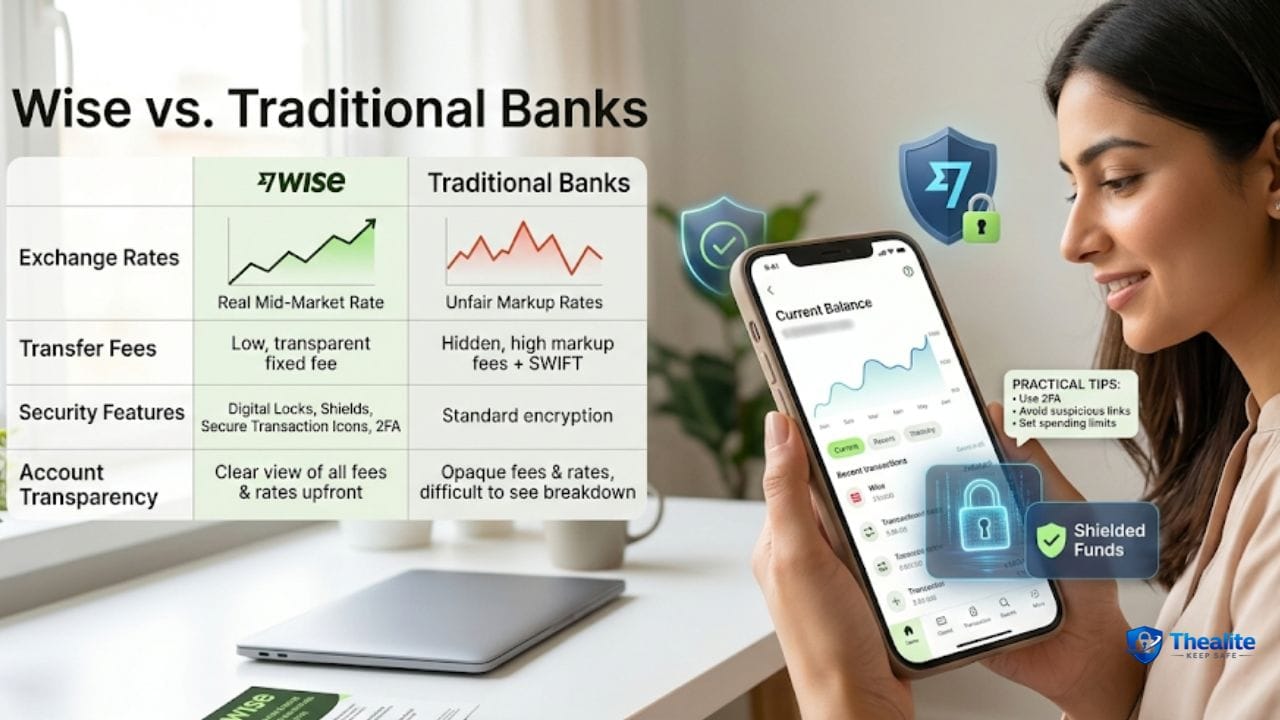
Wise (formerly TransferWise) is widely used in the U.S. for sending money internationally and holding multiple currencies. So it’s natural to ask: **is Wise safe to keep money**—especially if you plan to leave a balance there for days, weeks, or longer.
The realistic answer is: **Wise can be safe for holding money short-term and for everyday transfer use**, as long as you lock down your account security. But it’s important to understand how Wise differs from a traditional bank—and what protections do (and don’t) apply depending on how you’re using Wise.
This guide is written for a U.S. audience and explains: Wise balance vs bank balance, “safeguarding,” when FDIC pass‑through insurance may apply through Wise’s interest feature, and practical rules for deciding how much to keep on Wise.
Quick Answer
Wise is generally safe for holding **small to moderate operating balances** you plan to use for transfers or spending soon—especially if you enable strong security. However, Wise is not a traditional bank account, and **standard Wise balances are not automatically FDIC‑insured like a bank deposit**. In the U.S., Wise explains that it protects customer funds through **segregation/safeguarding** and may offer **FDIC pass‑through insurance** when you opt in to certain features (for example, Wise’s U.S. interest program for eligible customers). For long‑term savings or very large balances, many people prefer a traditional bank or credit union.
Step 1: Understand ‘Wise Balance’ vs ‘Bank Account Balance’
A bank account is built for holding deposits and is typically covered by FDIC insurance (up to limits) when the bank is FDIC‑insured. Wise is a financial technology company that provides money transfer and account features, but it is generally described as **not a bank**. That doesn’t mean it’s unsafe—it means the protection model is different.
Wise safety concept in plain English
- Wise says it keeps customer funds separate from Wise’s own operating money (segregation).
- Wise says it protects funds according to regulatory rules (often described as safeguarding).
- Some features may involve moving (“sweeping”) funds to partner banks or other structures that can change protections.
Step 2: Is Wise FDIC‑Insured?
This is the key question many U.S. users mean when they ask if Wise is ‘safe.’ Wise explains that standard Wise accounts are not automatically FDIC‑insured like a traditional bank deposit, because Wise is not a bank. However, Wise also explains that for eligible U.S. customers who opt into its interest feature, USD balances may be swept into FDIC‑insured program bank accounts (FDIC pass‑through) up to applicable limits, depending on the program details.
What this means for you
- If you want FDIC-style deposit protection, confirm whether your Wise setup/feature provides it and what the limits are.
- If you’re not opted into an FDIC-backed program feature, treat Wise like a strong transfer wallet—not your primary savings vault.
Step 3: What Are the Real Risks of Keeping Money in Wise?
Most risk for everyday users comes from practical issues—not dramatic scenarios.
1) Account takeover (the most common real-world risk)
If someone takes over your Wise login or email/phone used for verification, they may be able to send funds out quickly. This is the same risk you see with payment apps.
Related: How to Keep Your Identity Safe Online • How to Keep Your Password Safe • How to Keep Passwords Safe.
2) Scams and ‘authorized transfers’
Many losses happen when a user is tricked into sending money (phishing, fake support messages, ‘refund’ scams). These are harder to reverse than unauthorized hacking in many systems.
3) Access and verification delays
Any financial platform can require additional verification or hold transfers if activity looks unusual. That’s one reason it’s smart not to keep your entire emergency fund in any single fintech wallet.
4) Currency and conversion considerations
If you’re holding multiple currencies, the value in USD terms can change with exchange rates. That’s not a safety issue—just a planning issue. Keep ‘must-not-lose value’ funds in the currency you need.
Step 4: How Much Money Should You Keep in Wise?
A practical rule: **keep only what you need for near-term transfers, travel, or bills**—and keep long-term savings in a bank account.
A simple tier system
- Everyday transfer buffer: a small amount you might send/spend in the next week or two.
- Travel/operating balance: enough for planned expenses and transfers during a trip or month.
- Long-term savings: better kept in a bank/credit union (or another account designed for savings).
If you’re comparing options, see Is It Safe to Keep Money in Checking Account and Which Bank Is Safe to Keep Money.
Step 5: Make Wise Safer (Security Setup Checklist)
If you use Wise regularly, these steps reduce risk a lot:
Account security
- Use a strong, unique password (don’t reuse).
- Enable two-step verification / MFA if available.
- Secure your email account (email is the password reset key).
- Keep your phone locked (strong passcode + biometrics).
Anti-scam habits
- Don’t click ‘support’ links in random texts/emails—open the app/site directly.
- Verify recipient details before sending (especially first-time transfers).
- Don’t share verification codes with anyone.
Device safety
- Keep your phone and apps updated.
- Avoid logging into money apps over unknown public Wi‑Fi for sensitive actions.
- Turn on login/transfer alerts if available.
More: How to Keep Information Safe.
Step 6: What to Do If You Think Your Wise Account Was Hacked
Act fast. These steps reduce damage:
- Secure your email first (change password + enable MFA).
- Change your Wise password and sign out unknown devices/sessions.
- Contact Wise support through the official app/site.
- If a bank card/account is linked, notify your bank and monitor transactions.
- Change any reused passwords on other accounts.
Wise vs Venmo vs Cash App (Quick Comparison)
These tools overlap, but they’re built for different use cases. Wise is commonly used for international transfers and multi-currency holding. Venmo/Cash App are often used for domestic P2P payments. Safety strategy is similar across all: keep balances reasonable and secure your account.
Related comparisons: Is It Safe to Keep Money in Venmo • Is It Safe to Keep Money in Cash App.
Copy/Paste Checklist: Is Wise ‘Safe Enough’ for You?
- I understand Wise is not a traditional bank deposit account
- I keep only a near-term operating balance on Wise
- I’m opted into (or not relying on) any FDIC-backed program features intentionally
- I use a unique password + MFA and my email is secured
- I double-check recipients and avoid links/scam messages
- I monitor transfers and alerts and move large balances to a bank
FAQs
Is Wise a bank?
Wise generally describes itself as not a bank. It provides money services like transfers and account features under regulatory obligations.
Is Wise FDIC insured?
Standard Wise balances are not automatically FDIC-insured like a bank deposit. Wise says some U.S. features (such as its interest program for eligible customers) can provide FDIC pass-through insurance through program banks when you opt in.
Should I keep my savings in Wise?
Many people prefer keeping long-term savings in a traditional bank/credit union and using Wise for transfers and short-term balances.
What’s the biggest risk when keeping money in Wise?
For most users, account takeover or scams are the biggest risk. Strong passwords, MFA, and safe habits reduce this.
How can I reduce risk quickly?
Secure email + Wise with unique passwords, enable MFA, and keep only a reasonable balance on the platform.
Conclusion
Wise can be a safe and useful platform for holding money you plan to transfer or spend soon—especially for international use and multi-currency balances. But it’s smart to treat Wise like a high-quality transfer wallet, not your only long-term savings location. Keep balances reasonable, secure your account with strong authentication, and move larger savings to a bank or credit union built for long-term storage.

As a digital marketer, she has received multiple international awards, including Campaign of the Year at the 2023 European Content Awards and Best Use of Content Marketing at the 2022 Global Search Awards. Nicai holds an MSc in Marketing (First Class Honours) from the UCD Smurfit Graduate Business School and she has also completed the Artificial Intelligence Programme at Oxford University’s Saïd Business School. She is also a contributing writer for publications such as Entrepreneur and Esquire.